Diel Activity Patterns of Bobcats and Domestic Cats in the Houston Metropolitan Area
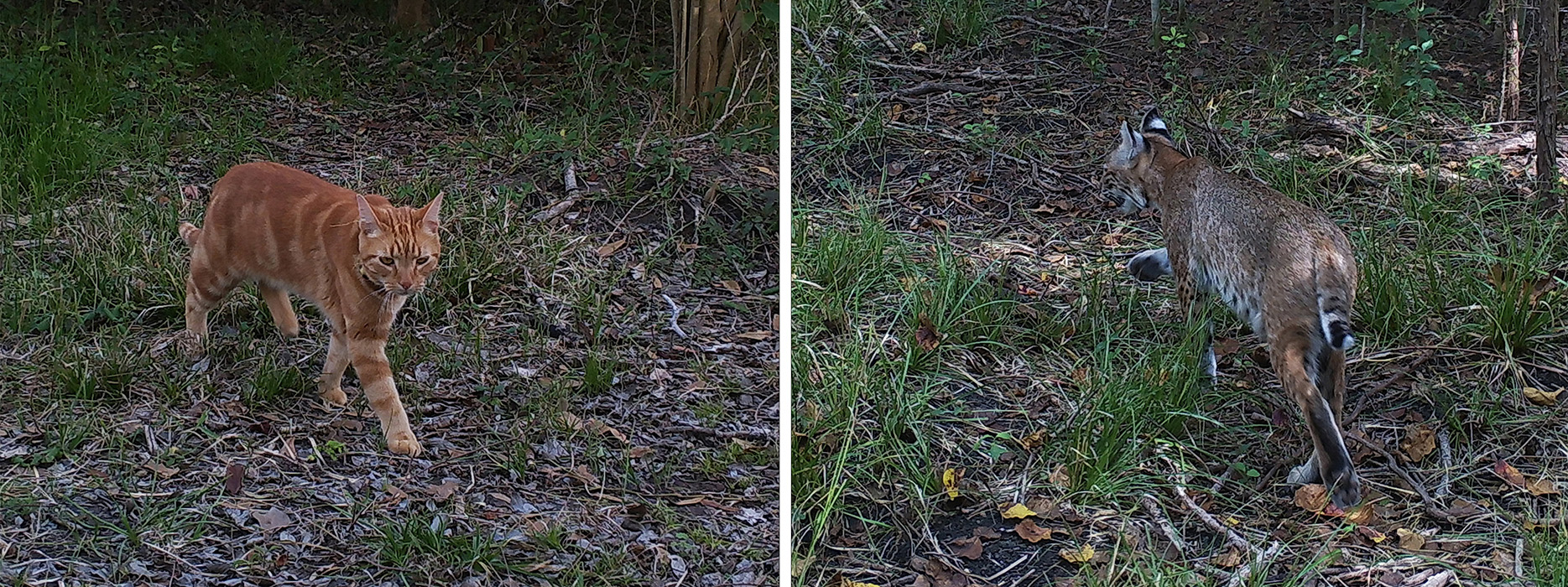
The curious coexistence of bobcats and domestic cats in the Houston metropolitan area was studied by a group of students in UH's BIOL 1306 course taught by Professor Ann Cheek. Representing the Honors College, the Department of Biology and Biochemistry, and the Department of Biomedical Engineering, Natalie Linde, Sarah Malik, Leila Alavi-Naini, and Yasin Syed investigated daily activity patterns of bobcats and domestic cats in the Houston metropolitan area. They began their work in the fall 2024 semester and continued their analysis through the spring 2025 semester with the goal of submitting a manuscript, which was published this summer in microPublication Biology.
"I was impressed throughout the process with the students’ motivation to take on all the challenges of moving from an interesting idea originally communicated in a short-term class project to writing a scientific paper for peer review," said Professor Cheek. "All four of them worked enthusiastically at all the tasks, including reading and complying with the details in the instructions to authors, creating their ORCID profiles, setting team deadlines, meeting standards for data management, learning new statistical methods and new mapping software to analyze their data, doing a literature search using specialist databases available through University of Houston libraries, revising the manuscript in response to reviewer comments, and drafting a letter to the editor to explain their responses."
The following is the Abstract:
We investigated whether bobcats (Lynx rufus) and domestic cats (Felis catus) exhibit distinct daily activity patterns or use different habitats in the Houston, Texas metropolitan area. Motion-activated cameras were deployed at 33 sites for 16 one-month sampling periods from 2020 to 2024. Bobcats exhibited primarily nocturnal activity wherever they were present. Domestic cats were primarily nocturnal at sites where no bobcats were detected. Bobcats and domestic cats overlapped at sites with a mixture of forest and developed land and domestic cats shifted to more daytime activity. Both temporal and spatial niche partitioning appear to facilitate predator coexistence in urban landscapes.
Read the research results here.