From Blank Page to 7 Modules: How AI Helped Build an AI Learning Course
Creativity and Ideation
Tracie M. Ford, Sr. Functional Analyst
AI Solutions
Tools
ChatGPT EDU, NotebookLM
Problem
A foundational AI learning course was needed for University of Houston staff and faculty, but the work started from a blank page. The course creator was still learning AI and did not have formal experience in instructional design, curriculum development, or graphic design.
Solution
ChatGPT Edu and NotebookLM served as content development partners, helping define and explain AI concepts, organize topics, sequence modules, create visuals, and provide critical feedback and invaluable end-user perspective. These AI tools improved the clarity and structure of the course and enabled it to be developed entirely in-house, maximizing existing resources without requiring outside curriculum development or graphic design support.
As part of the AI Solutions team, my role includes helping train the campus community on AI concepts and practical uses of AI tools.
When I needed to create a foundational AI learning course for University of Houston staff and faculty, the goal was clear: help introduce others to artificial intelligence in a practical, approachable way.
The challenge was that I was still new to AI myself.
I was not an instructional designer. I was not a curriculum developer. I did not have experience in graphic design. What I did have was a clear need, a blank page, and a willingness to learn as I went.
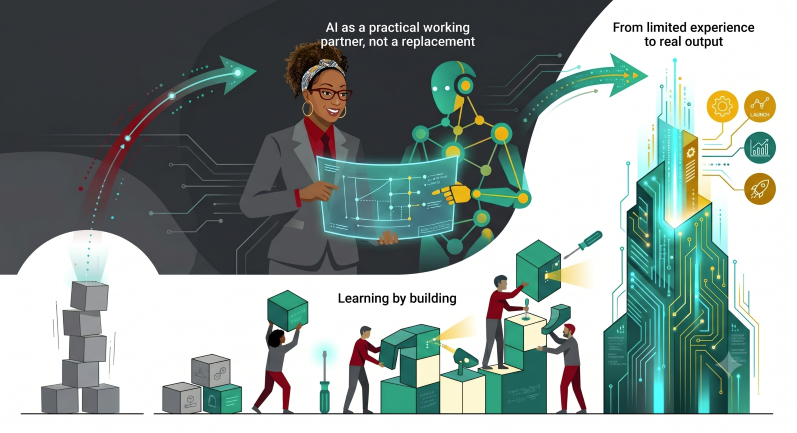
To get started, I used ChatGPT Edu and NotebookLM as working partners throughout the process. ChatGPT Edu became especially useful as I shaped the course content and structure. I used it to help identify common AI terms, organize topics, think through the order of the modules, create images and graphics, critique ideas, simplify complex concepts, and provide insight into course design and impact.
The work did not happen in a single prompt. It was an ongoing process of asking, testing, revising, and learning. I would bring an idea to the tool, review the response, decide what worked, and continue refining. Throughout the process, AI gave me critical feedback on what I should and shouldn't include, identified areas that needed clarification, and suggested ways to strengthen explanations and improve the flow between modules.
One of the most valuable aspects was the perspective AI provided as both an instructional designer and an end user. It guided me on what would make concepts easier for learners to understand, suggested improvements based on instructional best practices, and recommended where additional examples, visuals, or activities would create a better learning experience.
Just as important, AI did not replace human review or decision-making. Everything was reviewed for accuracy, and my manager provided direction and oversight throughout the process.

The result was a high-quality seven-module course created in just a few months.
That outcome mattered for reasons beyond speed. Using AI allowed me to develop the course in-house using existing resources, without needing outside curriculum development or graphic design support. It also gave me hands-on experience with the same tools and concepts I was helping others learn.
In the process, I gained more than a finished course. I gained confidence.
Because I was learning AI while building an AI learning experience, the work became both a project and a professional development opportunity. Each step helped me better understand what AI can do, that human judgment still matters, and how useful these tools can be when paired with a clear goal.
The quick win was not just getting from a blank page to seven modules faster. It was discovering that AI could help bridge gaps in experience, provide unique perspectives, and create something useful for others while strengthening my own skills and understanding along the way.
The example, details, and outcomes described in this article were provided by the contributor. AI tools were used to help organize and draft the article, which was reviewed and validated by human staff to ensure accuracy, quality, and appropriate oversight.