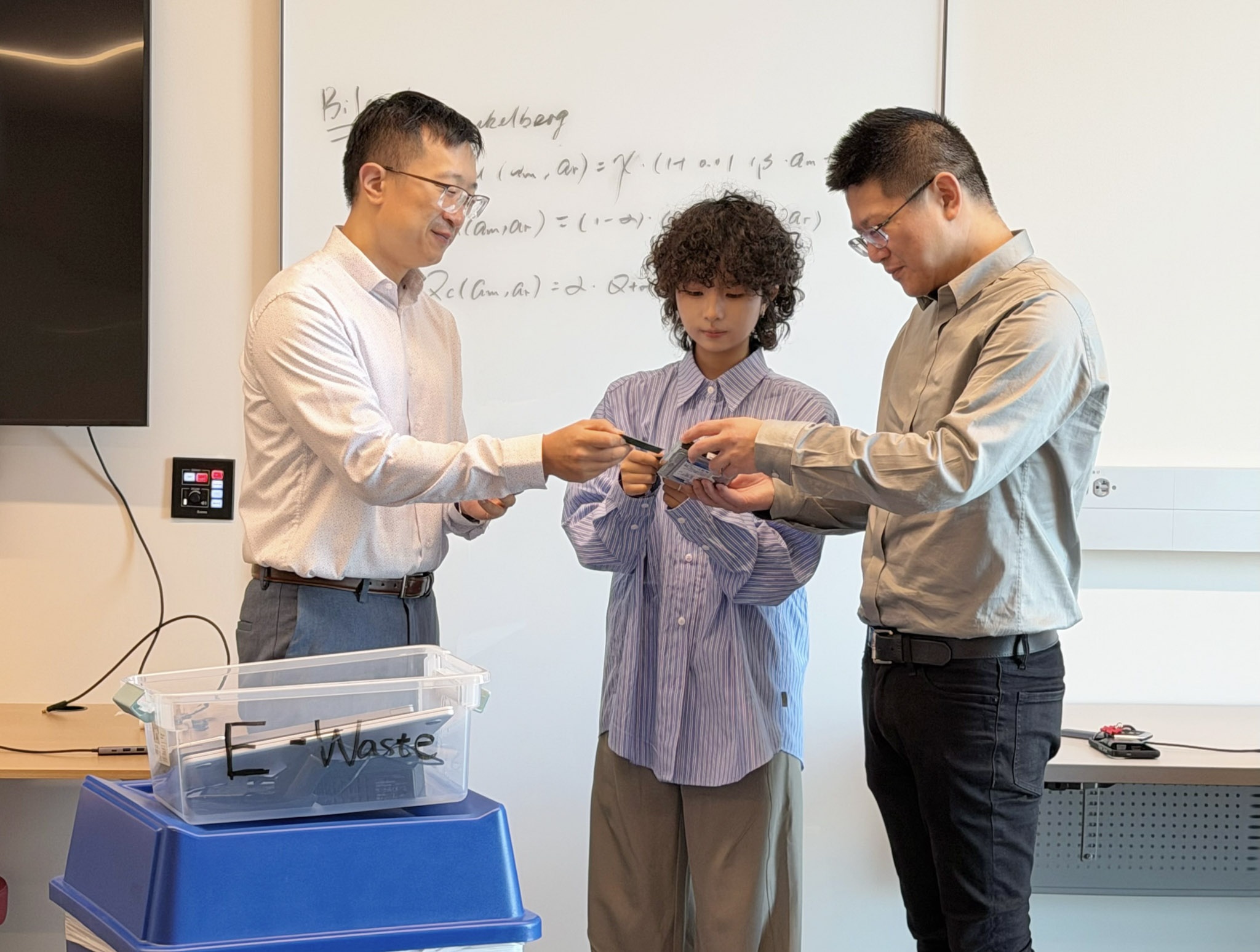
Professor Jian Shi, left, examines e-waste with Graduate Researcher Chuyue Wang and Professor Kailai Wang.
Inside America’s junk drawers sits an untapped fortune, and a national and economic security solution. As the global race for critical minerals intensifies, University of Houston researchers have unveiled a breakthrough supply chain model designed to transform e-waste from a mounting environmental hazard into a stable, domestic engine for the U.S. economy.
By solving the financial “missing link” that has long made large-scale recycling a losing bet for private industry, Professor Jian Shi and his team are providing the roadmap for a new era of “urban mining.” The research, co-authored by Professor Kailai Wang and Graduate Researcher Chuyue Wang, offers a strategic framework to reclaim the gold, lithium, and cobalt buried in discarded electronics, keeping these essential materials circulating within the U.S. instead of ending up in foreign landfills.
From Junk Drawers to Domestic Security
“A lot of people have iPads or old iPhones sitting in their drawers right now, and that’s a waste of a critical resource,” said Jian Shi, Associate Professor in the UH Cullen College of Engineering. “Urban mining allows us to extract the same high-value materials found in traditional mines without the environmental destruction. More importantly, it helps secure our domestic supply chain for the technologies of tomorrow.”
E-waste is currently the fastest-growing solid waste stream in the world, Shi’s research found. When left unmanaged, these devices represent a triple threat: they leak hazardous waste, pose significant fire risks due to aging batteries, and — perhaps most critically — represent a massive loss of "critical mineral sovereignty" for the United States.
Solving the Economic Bottleneck
The primary barrier to universal recycling hasn’t been a lack of will, but a lack of profit. The current ecosystem is a fragmented web of manufacturers, independent collectors, and material recovery firms that often work at cross-purposes.
“The challenge is that recycling systems are complicated and expensive,” Shi said. “Different companies handle sales, collection, processing and material recovery, which can make coordination difficult and limit large-scale recycling efforts.”
The UH team’s model changes the math. By mapping the interactions between manufacturers and independent recycling markets, the researchers developed a collaborative cost-sharing framework. This model identifies how these players can transition from competitors to partners, distributing profits more equitably and making the recycling process financially sustainable as a long-term business strategy.
“The big question we’re answering is how to make responsible recycling easier and financially attractive for everyone in the chain.”
—Kailai Wang, assistant professor of industrial engineering, University of Houston
“The bottleneck isn’t just the technology, it’s the coordination,” said Professor Kailai Wang. “The big question we’re answering is how to make responsible recycling easier and financially attractive for everyone in the chain.”
Powering the Future
As the U.S. pivots toward an electrified future, the demand for battery materials is skyrocketing. The research, which was supported by the U.S. Department of Energy’s (DOE) Vehicle Technologies Office, suggests that a smarter, integrated recycling system is the only way to meet these demands while bolstering national security.
“We can improve the performance of the entire recycling ecosystem and make the profit distribution more balanced,” added Chuyue Wang. “This ensures that the materials we need for EVs and advanced electronics stay right here in the U.S.”
“We are in a critical window for technological leadership,” Shi said. “By making recycling work at scale, we aren’t just cleaning up waste — we’re building a foundation that benefits both our national security and our economy.”
This work was supported by the U.S. Department of Energy’s Office of Energy Efficiency and Renewable Energy (EERE) through the Vehicle Technologies Office (Award No. DE-EE0011357). The views expressed are those of the authors and do not necessarily reflect those of the U.S. Department of Energy or the U.S. Government.