Accurately predicting ocean waves can be critical to everything from maritime safety and offshore operations to protecting energy infrastructure and preparing coastal communities for hazards. A University of Houston computer scientist is exploring how artificial intelligence can make those forecasts more accurate and help people make better decisions using the data.
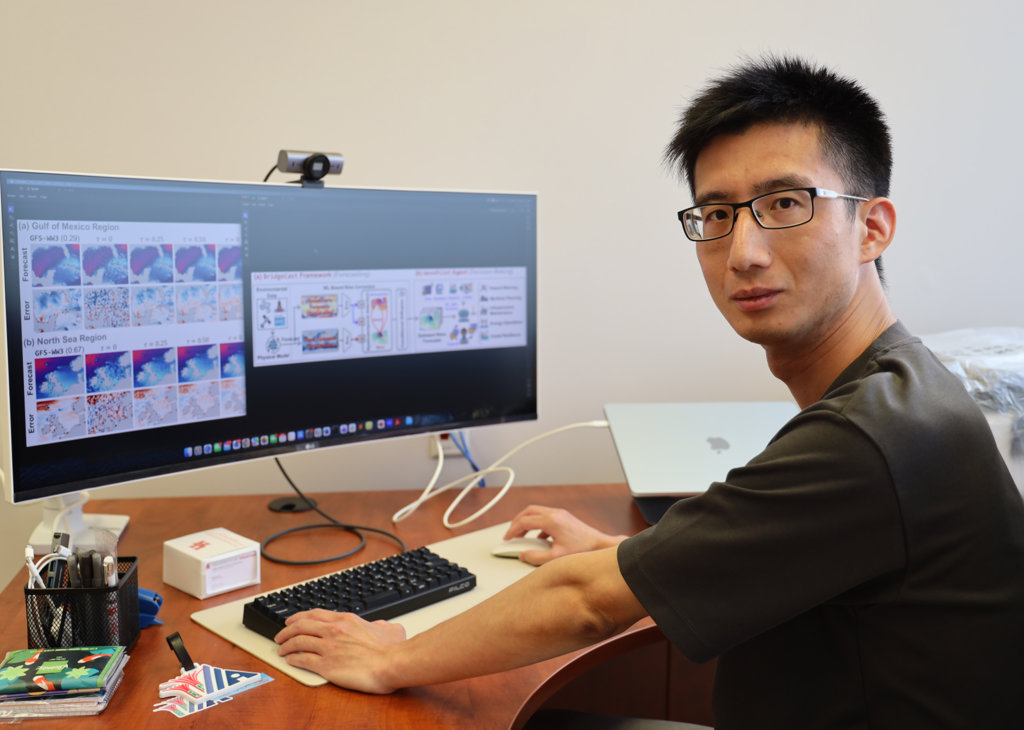
Jingchao Ni, assistant professor in the Department of Computer Science at the University of Houston, has received support through the NVIDIA Academic Grant Program for his research project, “WaveSentinel: An AI-Driven Predictive Engine for Ocean Wave Intelligence.”
Through the program, Ni will receive eight NVIDIA RTX PRO 6000 Blackwell Server Edition graphics processing units (GPUs), providing the high-performance computing resources needed to develop and test AI models using large-scale scientific datasets.
“This support not only recognizes our work but also provides essential computational resources to accelerate our research and development of time-series physics-AI systems for Earth science,” Ni said.
Bringing AI Into Ocean Wave Forecasting
Ocean wave forecasting relies largely on physics-based models. While those models are essential, Ni's research seeks to address two challenges: systematic biases that can affect forecasts and the time required to interpret complex information and make informed decisions.
WaveSentinel will combine physics-based forecasting with artificial intelligence. One part of the project will use AI to identify and correct biases in wave forecasts while maintaining consistency with the underlying physics. Another will develop an AI agent system that can analyze information from multiple sources, combining forecasting outputs with external data to assist with interpretation, summarization and decision support.
The approach could help turn large amounts of complex scientific data into useful information more quickly.
“What excites me most is the potential for this research to augment predominantly physics-based forecasting and expert-driven decision-making in ocean-related applications with AI, enabling more accurate predictions and more intelligent, efficient forecast interpretation and decision support,” Ni said.
Computing Power for a Data-Intensive Challenge
Developing those systems requires significant computing power.
The GPUs provided through the NVIDIA Academic Grant Program will allow Ni and his team to perform computationally intensive work, including model training, parameter tuning and AI agent development using high-resolution, large-scale scientific datasets.
“This support will enable us to perform the computationally intensive tasks required by this project, including model training, parameter tuning and AI agent development, using high-resolution, large-scale scientific datasets that would otherwise be difficult to process at this scale,” Ni said.
Ni will collaborate on the project with Kunxiaojia “Tammy” Yuan, assistant professor of Earth and Atmospheric Sciences, and her team, bringing together expertise from two departments in the College of Natural Sciences and Mathematics.
Why Better Wave Forecasts Matter
For coastal regions such as Houston and the Gulf Coast, the potential applications extend beyond the research lab.
Accurate wave forecasts can inform maritime operations, offshore activities, energy infrastructure maintenance, hazard mitigation and efforts to strengthen coastal resilience. Errors in those forecasts can lead to poor decisions and introduce safety risks in maritime and coastal operations.
“Ultimately, better forecasts and decision-making can benefit not only stakeholders such as industry operators, emergency responders, infrastructure managers and government agencies, but also coastal communities, individuals engaged in ocean-related activities and the broader public, particularly those in coastal metropolitan areas such as Houston,” Ni said.
The project reflects a broader effort to combine the strengths of established scientific models with emerging artificial intelligence technologies, using AI not to replace physics-based forecasting or human expertise, but to enhance both.