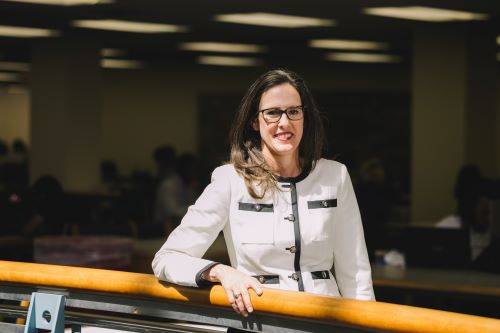
During the height of the semester, there is a moment—usually somewhere between midterms and finals—when I pause in the middle of one of our Libraries’ bustling spaces and take everything in. Students gather around whiteboards refining arguments, faculty members lead impromptu consultations with librarians, and quiet study rooms hum with focused determination. The energy is unmistakable: curiosity in motion, learning at full capacity, our campus at its most vibrant.
In these moments, I am reminded of why I became a librarian.
At a time when the information landscape is shifting faster than ever, with generative AI reshaping how we search, create, evaluate, and communicate, I return to the passion that brought me to this profession: teaching and championing transferable information literacy skills. These skills have anchored students for decades, even as the formats, tools, and technologies around them continue to evolve.
Over the course of my own career, I’ve watched our ecosystem transform from analog to digital collections, from indexes to full text, from early search engines to natural language search, and now from human-generated information to a world increasingly shaped by AI-assisted content creation. With each shift, information literacy has remained not just relevant, but essential. Today, it sits at the center of conversations across disciplines, helping our students and faculty navigate ambiguity, question sources, and build knowledge responsibly.
That is why I want to use this Dean’s Corner to spotlight the extraordinary work of our librarians who support students and faculty through teaching and research consultations. Our librarians bring expertise, creativity, and scholarly rigor to campus every day. This time of year, they are busier than ever, deeply immersed in the work they love and making a measurable difference in the academic lives of our students.
Here are just a few ways they are elevating learning across the University:
Information Literacy Instruction: Intentionally aligned with course learning outcomes across disciplines—from engineering to the arts, and from the social sciences to the health professions. These sessions help students sharpen skills in source evaluation, ethical information use, and research strategy.
Self-Guided Tutorials: A robust suite of tutorials and videos that empower learners to build confidence at their own pace, anytime and anywhere.
Embedded Learning: Dynamic online information literacy lessons that faculty can embed directly into
their courses to reinforce research and critical thinking skills.
Data + Donuts: A networking series that brings together researchers from across campus to explore
how data is consumed, produced, preserved, and shared.
Digital Humanities Core Micro-credentialing: A program helping scholars gain specialized expertise in digital methods and tools that are reshaping humanities research.
Open Education Program: A thriving initiative that supports faculty in reducing course material costs while fostering innovative and more inclusive ways of teaching and learning.
What makes these contributions even more extraordinary is that our librarians do more than sustain essential services; they continually advance them. Through their own research and scholarship, librarians advance the methodologies and practices that shape how we learn, teach, and conduct inquiry. This ongoing intellectual work directly enriches the expertise they bring to our campus community and enhances the quality of support they provide.
Spotlight on Excellence
I’d like to highlight two Assistant Librarians who were recently selected as the 2025 recipients of the Dana C. Rooks and Dr. Charles W. Rooks Early Career Librarian Fellowship. This fellowship is designed to help assistant librarians develop a robust research agenda in their pursuit of the rank of Associate Librarian and beyond.
Kate Carter, Open Education Librarian: Kate is conducting qualitative research on the experiences of open education learners and professionals. Her work provides insights into how we can better support both faculty and students as they adopt and adapt open practices.
Natalia Kapacinskas, Teaching and Learning Librarian: Natalia is examining autoethnographies of librarians with disabilities, shedding
light on how lived experience shapes the profession and how we can build a more inclusive
environment for library workers and learners alike.
Their scholarship reinforces the important fact that librarians are educators, researchers, and thought leaders. They are essential partners in student success and faculty innovation, and they purposefully push the boundaries of how libraries support learning in an ever-changing world.
As we move through another spirited and demanding semester, I hope you will join me in appreciating their work and reaching out to partner with us in pursuit of student success and research excellence. Our students thrive when we work together. Our faculty innovate when we work together. And our campus is stronger because UH Libraries is committed to empowering curiosity, knowledge, and discovery.