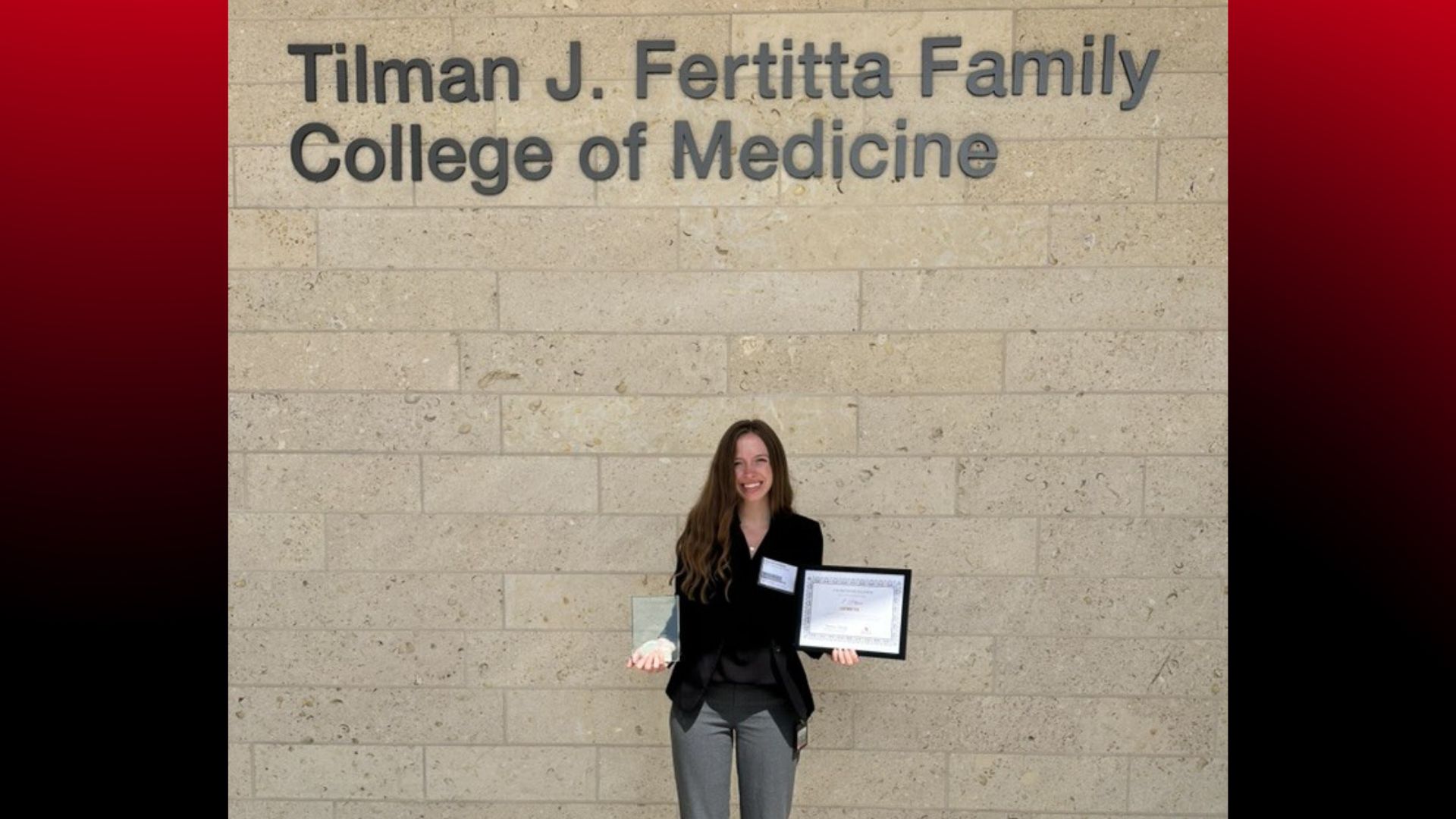
The Tilman J. Fertitta Family College of Medicine celebrated a major milestone this August with its second annual Student Research Day, an event designed to highlight the innovation, dedication and curiosity of the college’s future physicians. Thirty-eight medical students presented original research spanning the biomedical, clinical, and public health sciences, sharing discoveries that reflect the college’s mission-driven approach to advancing health and improving care for communities.
Student Research Day showcased work completed through summer programs, academic-year research, and partnerships with institutions across the country, including the University of Houston, University of Texas Medical Branch, Rice University, University of Utah, Stanford University, Swansea University, and Washington University School of Medicine. Through poster sessions and fast-paced, five-minute Lightning Talks, students shared projects that ranged from molecular science and pathology to health systems research and community-focused investigations. The event provided a platform for students to gain experience presenting their work to peers, faculty, and community members while fostering interdisciplinary collaboration and sparking new ideas for future scholarly contributions.
The importance of Student Research Day is closely tied to the College’s mission: educating a diverse group of physicians committed to compassionate, high-quality, and cost-effective care; conducting interdisciplinary research that drives innovation; delivering evidence-based, high-value care through interprofessional teams; and partnering with communities to improve population health. By engaging students early in research, the college builds the foundation for future physician-leaders who understand not only how to deliver care, but how to transform the systems in which care is delivered.
For many students, the event marked the culmination of months of effort and the beginning of new academic and professional opportunities. Hannah Jenkins, a second-year medical student, spent the summer at the University of Utah through the Pathology Integrated Scientific and Clinical Experience for Students. She was paired with pathologist Kim Evason and mentored daily by researcher Sharanya Kalasekar while studying tyramine’s role in activated β-catenin-induced liver enlargement in zebrafish. The model mirrors aspects of human hepatocellular carcinoma, giving the work direct relevance to cancer research. Jenkins’ team found evidence suggesting tyramine may help reduce abnormal liver growth, identifying a potential therapeutic avenue for further investigation.
“The experience deepened my appreciation for the research process,” Jenkins said, reflecting on the months spent in the lab and the opportunities to present her findings. She shared her poster at both the program’s closing symposium and at Student Research Day, where she also delivered a Lightning Talk. “Sharing my work and being recognized in both categories meant a lot to me. This project affirmed my passion for pathology and showed me how even small contributions can advance our understanding of disease.”
Faculty mentors echoed the value of such experiences. Diego Alvarez, M.D., Ph.D., clinical professor of physiology, described research mentorship as a process of guiding a student’s curiosity into structured scientific inquiry. “It’s about helping them transform questions into hypotheses, ideas into experiments, and observations into meaningful insights,” he said. “The moment when a student uncovers something new, when they realize their discovery contributes to a broader understanding of medical knowledge, is deeply rewarding.”
Alvarez emphasized that opportunities like Student Research Day are rare worldwide and reflect the College of Medicine’s commitment to nurturing excellence. “We are fortunate to work with exceptionally talented individuals being trained at the highest level,” he said. “Events like this inspire transformative contributions to the health of our communities.”
Tameka Clemons, Ph.D., the college’s assistant director of medical student research, shared insight into launching the first-ever event and the significance it holds for the program’s future. With 38 students participating across diverse research areas, Clemons described the event as a celebration of student effort and an affirmation of the college’s commitment to scientific discovery. Research presented at the event represented both summer and academic-year projects, demonstrating the depth and continuity of student scholarly engagement.
“The purpose of Student Research Day is to highlight the hard work students have put into their research efforts and to underscore the importance of research for advancing science,” Clemons said. New workshops, such as sessions on creating effective presentations, have already been added to enhance future programming.
Clemons also emphasized the importance of strong mentor-student relationships, noting that mentors guide students through project design, scientific processes, presentations, and even applications to external conferences. Her own mentoring history reflects this long-term commitment: a student who joined her lab through the STEM RISE program in 2023 continued working with her for more than a year, earning multiple undergraduate research awards and is now preparing applications for Ph.D. programs under her guidance. “It is incredibly rewarding to see students develop skills that will serve society,” she said.
Interest in research continues to grow among incoming students. Clemons and her colleagues have already met with more than a third of the Class of 2029 to discuss potential opportunities. As the program expands, stronger connections between the Office of Student Research and mentors across institutions, including Baylor College of Medicine and Stanford, are paving the way for students to shine nationally.
Student Research Day reflects the college’s mission in action: empowering students to engage deeply with scientific inquiry, collaborate with interdisciplinary teams, and contribute to meaningful improvements in health care. As future events build on this momentum, the College of Medicine is poised to continue fostering physician-leaders who push the boundaries of discovery and deliver compassionate, evidence-based care to the communities they serve.