The quarterly survey of the SPACE City Panel examined public attitudes toward donations, particularly political giving. (Credit Getty Images)
Key Takeaways
- Many Houston-area residents say they are unlikely to donate to political campaigns in upcoming elections, pointing to limited grassroots participation in campaign fundraising, according to a new University of Houston survey.
- Many respondents report discomfort with large political contributions and uncertainty about campaign finance reforms.
- When residents do give politically, their decisions are driven primarily by candidates’ positions on inflation and core public services, such as health care and reliable and affordable electricity.
Nearly half of Houston-area residents donated to a cause in the past year, but fewer than one in 10 gave directly to political campaigns, highlighting widespread disengagement from political fundraising ahead of the statewide primary elections, according to a new University of Houston survey.
Released as part of the SPACE City Panel from the Hobby School of Public Affairs’ Center for Public Policy, the survey shows respondents are most likely to donate money toward charitable and nonprofit organizations (43.8%), while only 8.8% contributed directly to politics and 9.9% to crowdfunding or social appeals.
The report examines public attitudes toward donations, particularly political giving. Researchers found many respondents lack well-formed views about campaign finance distinctions and are unlikely to make a political contribution in the future.
“What the survey captures is a persistent tension in campaign finance: people are actively giving in their communities, but they’re largely sitting out of politics as donors,” said Agustín Vallejo, lead researcher on the report and research assistant professor at the Hobby School. “At the same time, many respondents say they’re uncomfortable with large political donations, even though relatively few plan to contribute themselves, so the public concern about money in politics isn’t automatically translating into broader participation through small-dollar giving.”
Following the Money
Nearly 62% of respondents reported giving less than $500 to any cause in the past year, with the most common donation range being between $50 and $199. Larger contributions were less common: 38.3% donated $500 or more, and about one in 10 reported donations of $5,000 or higher.
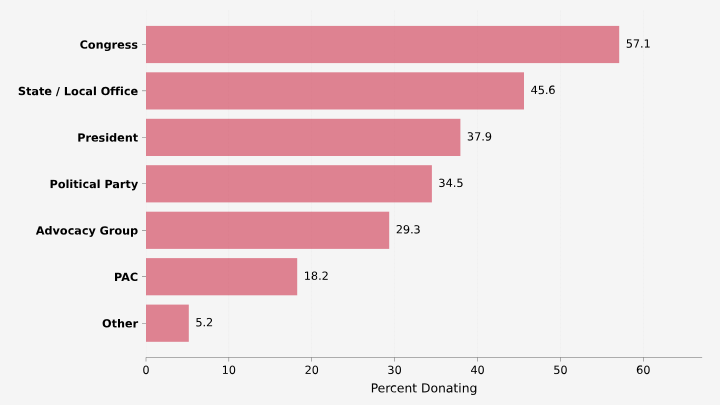
Among those who donated politically, congressional campaigns were the most frequent recipients (57.1%), followed by state or local races (45.6%).
Other findings include:
- More than 30% of political donors contributed to presidential campaigns and political parties, while fewer gave to advocacy groups (29.3%) or political action committees (18.2%).
- Nearly half of respondents (47.1%) neither agree nor disagree that campaigns should prioritize expanding small-dollar participation, defined as individual contributions of $200 or less.
- A majority (55.5%) reported discomfort with large political donations, meaning those over $20,000. Republicans or Republican-leaning respondents were most comfortable with large donations (20%) compared to Democrats (8.7%) or independents (7.7%).
- Familiarity with PACs was generally limited, and better-known PACs drew more disapproval than approval. For example, 39% of respondents disapproved of their preferred candidate accepting contributions from Blue Cross Blue Shield, the most well-known PAC.
Digging Deeper
Survey results show the strongest motivators for political giving were candidates’ positions on reducing inflation and providing core public services, including health care, energy affordability, public safety and job creation.
“Among political contributors, 94% said reducing inflation was an important factor in their decision to donate to a candidate, while nearly nine in 10 cited health care as a key motivator,” said Gail Buttorff, a report co-author and co-director of the Center for Public Policy.
By contrast, increasing tariffs on foreign goods and immigration restrictions were more likely to be rated “not important,” at 55% and 45% of respondents, respectively.
“It's notable but unsurprising that two pillars of President Donald Trump's immigration and economic agenda stand out as negative outliers,” said Pablo Pinto, a report co-author and director of the Center for Public Policy. “Given the partisan composition of Greater Houston, these are not animating issues for political donations, relative to other issues.”
Overall, most respondents (51%) said it’s “extremely unlikely” they will donate in upcoming elections, while about one in five said they were neither likely nor unlikely to contribute, though Democrats were about twice as likely as Republicans or independents to say they would contribute.
“If these patterns hold in the primaries, campaigns may be drawing from a relatively narrow donor pool,” Vallejo said. “The results suggest fundraising could continue to depend heavily on a smaller group of highly engaged donors or large donations and political action committees, rather than broad-based small-dollar participation.”
The full report is available on the Hobby School website. The survey was conducted in December. The first report focused on perceptions of Education Savings Accounts, and the final report for this quarter will cover perceptions of Chicago and Houston.