
As electronics have become more powerful, controlling heat in data centers has become a challenge. Photo courtesy Getty Images
A University of Houston professor has taken on the global challenge of reducing the staggering amount of heat generated in artificial intelligence data centers.
Hadi Ghasemi, J. Willard Gibbs Distinguished Professor of Mechanical & Aerospace Engineering,
has found that thin films designed into tree-like, or branched shapes release heat
at least three times better than today’s best methods.
High-power AI data centers generate substantial heat due to dense GPU and accelerator
deployments operating at extreme power densities. Efficient dissipation of that extreme
heat is critical to ensure the operational stability, reliability and longevity of
these systems.
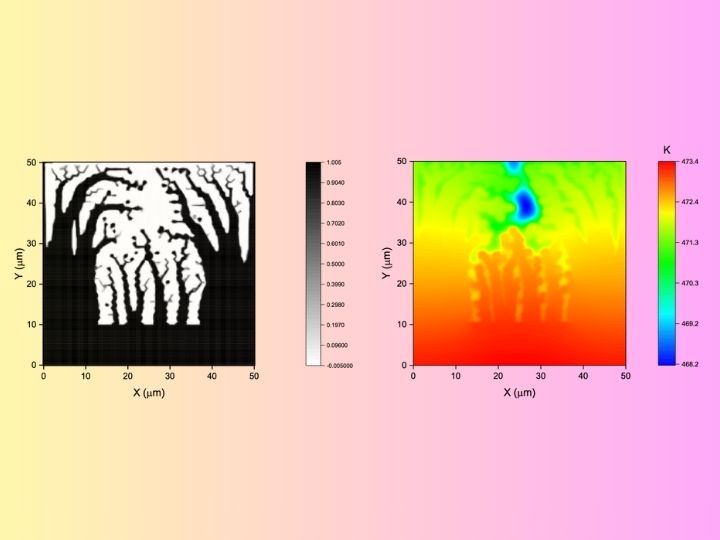

“Beyond achieving record performance, these new findings provide fundamental insight into the governing heat-transfer physics and establishes a rational pathway toward even higher thermal dissipation capacities,” said Ghasemi, who reported his findings in two articles in International Journal of Heat and Mass Transfer. Much of the work was also conducted by two of Ghasemi’s doctoral candidates, Amirmohammad Jahanbakhsh and Saber Badkoobeh Hezaveh.
The ascension of thin films
Remarkable advances in modern electronics, photonics and power systems have led to significant increases in power density while simultaneously introducing complex challenges related to thermal management.
Traditional cooling methods, including microchannels flow and spray cooling, have shown limitations when exposed to extreme heat flux because the liquid layer over the heat can become unstable as it evaporates, impeding its ability to carry away heat.
“Thin film evaporation is a promising thermal management strategy due to its inherent ability to sustain high heat fluxes with minimal thermal resistance,” said Ghasemi.
Still, scientists are figuring out how best to design thin film evaporation structures for their best efficiency. To address this, Ghasemi used two advanced computer methods — coupled topology optimization and an AI model — to determine that the best shapes for thin film efficiency are branches like those on a tree that are about 50% solid and 50% empty space.
“These structures could achieve high critical heat flux at much lower superheat compared to traditionally studied structures,” reports Ghasemi. “The new structures can remove heat without having to get as hot as previous removal systems.”
Ghasemi said the results demonstrate how physics-aware AI design can enable validated, high-impact cooling solutions for next-generation electronics and photonics.