Magnetic Resonance Imaging, or MRI, can cause unexpected issues for patients with implanted electrodes.
A University of Houston engineering professor is warning that implanted cuff electrodes — widely used in therapy for epilepsy, depression and inflammatory disorders — could trigger unintended nerve stimulation for patients undergoing an MRI scan.
The implanted electrodes, which stimulate the vagus nerve, are metallic and positioned near the nerve bundle, so their presence in an MRI environment raises concerns about nerve stimulation due to fast-switching gradient coils and radio frequency coil-induced heating near nerve fibers.
The study, led by Ji Chen, professor of electrical and computer engineering at UH, used detailed computer simulations to examine how MRI fields interact with the cuff electrodes.
“We found that patients with implantable devices may experience unintended nerve stimulation during MRI, which could cause discomfort or pain,” Chen said.
“This suggests that current MRI safety guidelines may not fully account for implanted nerve cuffs, and that more refined guidelines and careful safety considerations are needed.” Chen reported his findings in the journal Magnetic Resonance in Medicine.
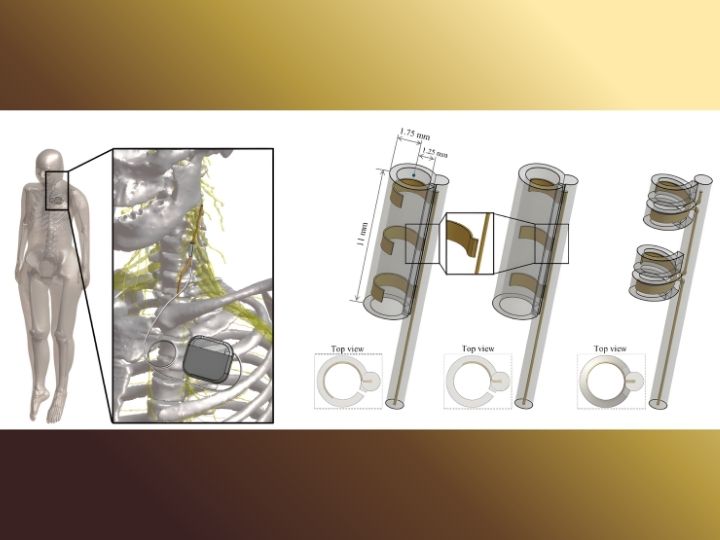

The results indicate that the presence of the cuff electrode significantly reduces the activation threshold, or minimum electrical level needed to trigger a nerve response, under gradient field exposure, while RF-induced heating further decreases the threshold for stimulations with short pulse durations.
Chen said the findings should be interpreted as preliminary indications of safety under controlled conditions and future testing is needed.
“For RF-induced heating safety assessment, multiple human body models, more imaging landmarks, more implantation pathways, and different polarizations should all be considered,” he said.
Chen’s team is developing methods and new designs to mitigate these risks in future cuff electrodes.