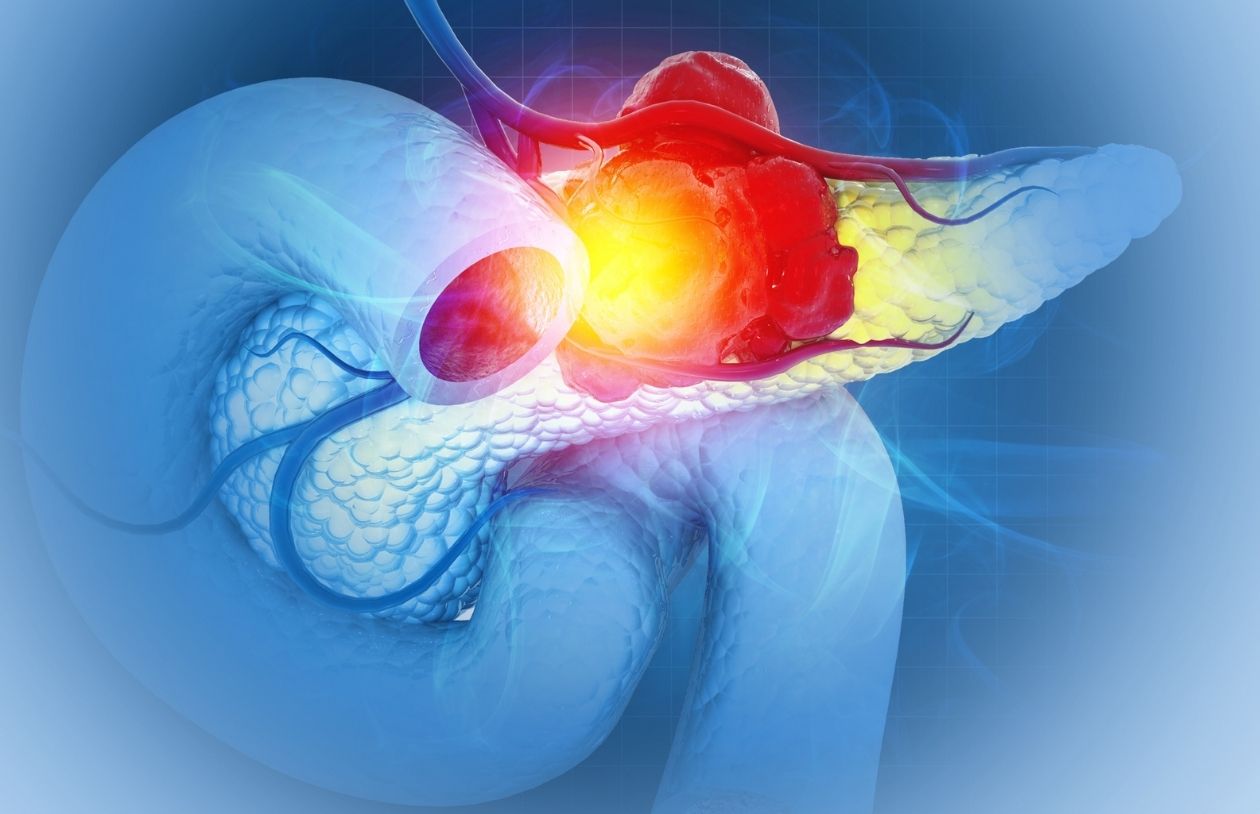
Researchers showed that their newly developed nanomedicine increased the survival of pancreatic cancer to 201 days, while most therapeutics do not show any efficacy. It also decreased tumor metastasis and invasion in the lungs. Illustration of cancer formed in the cells of the pancreas courtesy: Getty Images
A national team of researchers is reporting a new strategy to treat pancreatic cancer — by boosting the immune system. Pancreatic ductal adenocarcinoma is one of the deadliest cancer types, with a five-year survival rate of only 13%. It is also resistant to immunotherapy, where the body’s immune system attacks tumor cells.
The research team, including Wei Gao, assistant professor at the University of Houston College of Pharmacy, and led by Duxin Sun, professor of Pharmaceutical Sciences at University of Michigan College of Pharmacy and Rogel Cancer Center, developed a new dual-target drug, SH-273, and a nanoparticle version of it, Nano-273, to treat pancreatic cancer through boosting the immune system to help overcome immunotherapy resistance in pancreatic cancer. Their research is published in the journal Nature Cancer.
“We wanted to develop a drug molecule that could adaptively stimulate the helpful pathways while inhibiting the harmful ones,” said Sun.
Previously, researchers had identified compounds that boost the effectiveness of immunotherapy agents called STING agonists. STING, or STimulator of Interferon Genes, activates specific parts of the immune system, helping the body fight tumors.
In the new study, the team found that although STING agonists were able to overcome immunotherapy resistance driven by myeloid cells, they also induced resistance by increasing the number of regulatory B, or Breg, cells. Breg cells are a type of immune cell that actually help tumors grow by blocking the body’s natural defenses. They also discovered that the enzyme P13Ky, which regulates STING agonists, induced Breg cell expansion.
In mouse models and human cells derived from patients with pancreatic cancer, the
team proved that using STING agonists and inhibiting PI3Kγ can reduce Breg cells and
more effectively activate immune systems against cancer.
Based on these findings, the researchers developed the new drugs.
“Our team developed Nano-273, a dual-function nanodrug packaged in a tiny albumin-based particle. Nano-273 both activates STING and blocks PI3Kγ—a pathway that drives Breg expansion, while albumin nanoparticles help deliver the drug directly to immune cells, reducing unwanted side effects,” said Gao. “This approach reduces harmful Bregs while boosting immune cells that attack cancer, leading to stronger and more targeted anti-tumor responses.”
The researchers showed that the new nanomedicine increased the survival of pancreatic cancer mouse models to 201 days, while most therapeutics do not show any efficacy in these mice that bear the same mutations as human pancreatic cancers. It also decreased tumor metastasis and invasion in the lungs and was not toxic to the animals.
“It is significant that a treatment has improved survival for such a long time in mice with pancreatic tumors,” Sun said.
“This work represents the first discovery of a therapeutic target that eliminates regulatory B cells during STING activation, simultaneously overcoming resistance mechanisms driven by both Bregs and myeloid cells,” said Gao.
“The approach could lead to a new form of immunotherapy potential of achieving durable tumor control and improved survival outcomes for patients with pancreatic and also lung cancers.”

Wei Gao
Assistant Professor at the University of Houston College of Pharmacy
Gao recently announced receipt of a $900,000 grant from the Cancer Prevention and Research Institute of Texas to advance Nano-273 toward clinical trials. The grant will fund safety studies in large animal models and investigations into how Nano-273 enhances standard treatments, including chemotherapy and immune checkpoint inhibitors, in both pancreatic and lung cancer models.
The team hopes to advance SH-273 in phase 1 trials and will continue to investigate additional immune mechanisms that can be harnessed to overcome immunotherapy resistance.