Robert E. Sheriff Lecture
- Maximum of 30 students allowed to present posters.
- Poster Abstract Submission:
- Submit your Poster Title/Abstract PDF here. This counts as your RSVP; please do not RSVP using the HGS registration link below.
- To complete the submission form, please read the following:
a. Instructions to Student Presenters
Submission Deadline: Oct 27th at 10:00 pm.
- Students not presenting posters: need to register with HGS
The categories will be:
- Undergraduate & 1st year MS students
- Advanced MS students & 1st year PhDs
- Advanced PhD students
Award Amounts:
- 3 prizes in each category - prize amounts will be 750$/1st , 500$/2nd and 250$/3rd prize
A blockbuster evening! The 28th Annual Robert E. Sheriff Lecture
Deducing Tectonics from Sedimentary Basin Response
Kurt Rudolph, University of Houston

Contact: kwrudolph54@gmail.com
Bio:
Kurt Rudolph worked as a petroleum geologist from 1978-2015, mostly in exploration and research. The last 13 years of his industry career, he served as Chief Geoscientist for ExxonMobil. Kurt is currently an Adjunct Professor at Rice University and the University of Houston. He has won best paper awards for the AAPG Bulletin (1992 and 2017) and the Mountain Geologist (2015). Kurt was an AAPG-SEG Distinguished Lecturer in 2001-2002 (DHI/AVO Analysis) and 2023-2024 (Laurentian Orogenesis). His interests are tectono-stratigraphy, sedimentary basin evolution, sequence stratigraphy, seismic interpretation, and uncertainty analysis (risking/assessment/economics). Areas of active research include the evolution of late Paleozoic basins of North America, the transition from Sevier to Laramide orogenesis, and New Mexico stratigraphy.
Abstract:
Interpreting the tectonic history of ancient systems is beset with challenges – for example, subsequent deformation/exhumation destroys primary evidence, plate reconstructions are under-constrained, and thermochronology estimates exhumation, not uplift. However, linked sedimentary basins contain a complimentary suite of observations that can be used to help infer the timing, magnitude, and location of contractional and extensional tectonic events. While this information is less direct, it is often better preserved. We will illustrate this with a variety of approaches and examples.
Basin subsidence/uplift is driven by tectonics – for example, thrust belt uplift and flexural load in contractional systems, crustal thinning and heating/cooling in extensional cases, and mantle flow for dynamic topography. Basin and flexural modeling are used to characterize these events in space and time. Sedimentary cyclicity is a product of sedimentary supply versus accommodation; accommodation changes over long durations (>1 m.y.) are dominated by subsidence and uplift, rather than eustasy. Therefore, long-term cyclicity is usually driven by tectonics, and large-scale stacking patterns can be used to infer the nature of these drivers. Additionally, the relationship to petroleum system elements is profound, especially with respect to source rocks.
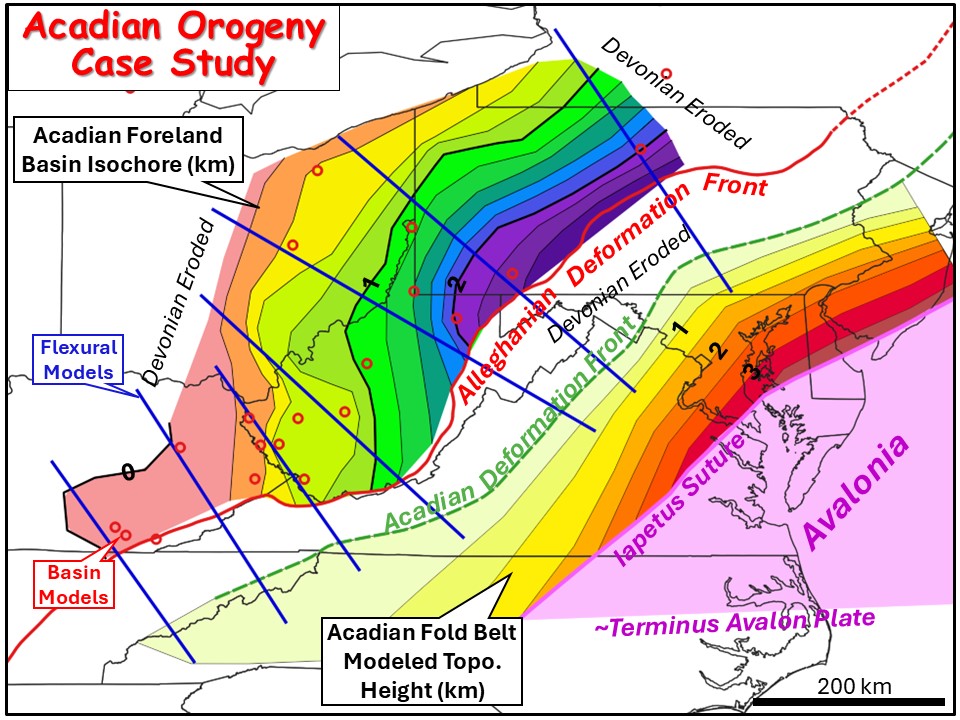
These methods will be illustrated with case studies from the Appalachian Basin, Western Interior, North Sea, North Slope, East Sarawak Basin, and elsewhere. One example is cited here - for the Devonian Acadian Orogeny of Laurentia, sedimentary patterns (isopach thicks, modeled flexure, subsidence history, Marcellus Shale and Catskill Delta distribution) are used to infer the location of the colliding Avalonia microplate.
Registration
Please visit the HGS website to register
Sheriff Lecture Committee
William Struble (chair), Jiaxuan Li , and Caroline Wachtman
Judges Needed for Poster Session
We invite interested professionals willing to serve as poster judges to contact Jeanette Kennedy at office@hgs.org
*****************************************