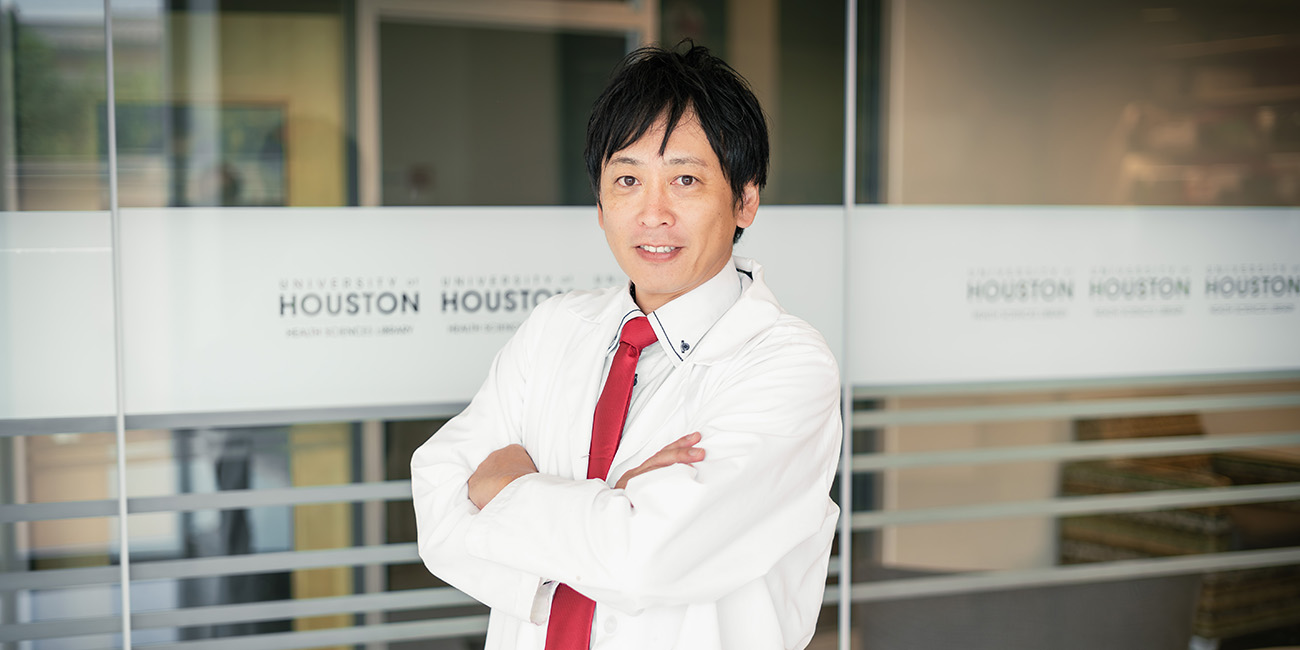
The University of Houston College of Pharmacy (UHCOP) recently welcomed gastrointestinal (GI) stem cell and organoid researcher Sumimasa Arimura, Ph.D., as a research associate professor in the Department of Pharmacological and Pharmaceutical Sciences.
Arimura’s research focuses on GI organoids, which are three-dimensional clusters of cells grown in a lab from stem cells that recapitulate key features of the structure and function of GI tissues, as well as cell-fate engineering, multicellular tissue design, regeneration and cancer therapy. His research program investigates how cellular identity is established, maintained and reprogrammed in health and disease, with the goal of translating those discoveries into regenerative therapies and more durable approaches to cancer control.
Most recently, Arimura served as a research assistant professor in the Department of Medicine, Section of Gastroenterology, at Baylor College of Medicine (BCM). He previously spent more than six years as an instructor in the department after completing postdoctoral fellowships at the University of Houston and BCM. Earlier in his career, he served as an assistant professor in the Division of Genetics at the Institute of Medical Science at the University of Tokyo.
Arimura has developed several research platforms spanning GI stem cell differentiation, organoid transplantation, epithelial replacement and cancer modeling. His work includes approaches to generate functional GI epithelial cells with defined identities and to develop multicellular models incorporating epithelial, stromal, immune and microbial components.
His research also examines new strategies for cancer prevention and treatment, including cell-fate engineering and locally targeted pharmacologic strategies. Among his current and upcoming projects, Arimura is the principal investigator on an award from the Japan Society for the Promotion of Science to develop a differentiation-based therapy for multiple epithelial cancers. He has also played a key role in advancing a Cancer Prevention and Research Institute of Texas-funded project developing locally bioavailable COX-2 inhibitors to prevent colon cancer progression in children with familial adenomatous polyposis, initially serving as a multi-principal investigator with Drs. Ming Hu and Gregory Cuny.
Arimura’s research has appeared in such peer-reviewed journals as Science, Cell Stem Cell, Gastroenterology and Cancer Research Communications.
Arimura earned his Ph.D. in cancer biology from Kyoto University Graduate School of Medicine, a master’s degree in pharmacology from Showa Pharmaceutical University and a bachelor’s degree in pharmacy from Showa Pharmaceutical University in Japan. He also worked as a clinical pharmacist in Kyoto for more than five years and maintains an active pharmacist license in Japan.
His honors include the 2025 United Japanese Researchers Around the World Paper Award, a Pilot/Feasibility Award from the Texas Medical Center Digestive Diseases Center and research fellowship awards from the Uehara Memorial Foundation and Mochida Memorial Foundation. He has also served as executive director of the Japanese Researchers Association of Science and Technology in Texas since 2019.