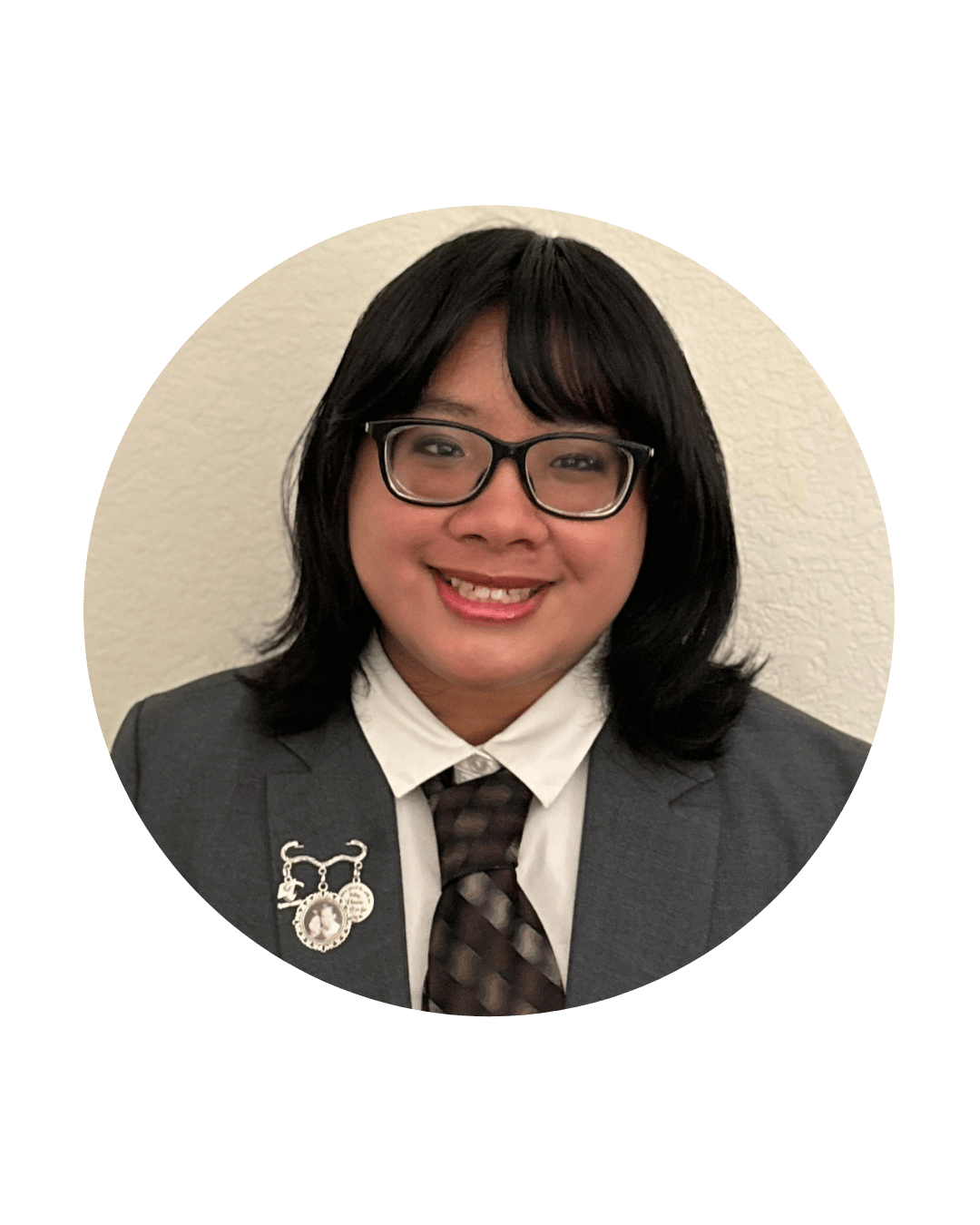
Samantha Pueblos shares her passion for advancing access and equity through people‑centered technology
For Sam, technology has never been abstract or optional—it has always been personal.
Born in the Philippines in 2003, Sam moved to Chicago as a toddler before settling in Texas around 2012. Texas has been home ever since, where she completed K–12 schooling in Katy and began navigating systems that were not always designed with her in mind. As a blind student, Sam learned early how much access—or the lack of it—could shape a person’s opportunities. That lived experience would ultimately inform not only her academic path, but the values she now brings to the intersection of social work and technology.
Sam completed her Bachelor of Social Work at the University of Houston–Downtown, graduating in Spring 2025. She chose to pursue her advanced degree at the University of Houston Graduate College of Social Work after hearing strong recommendations from UHD alumni and seeking an in‑person learning environment grounded in community. Just as importantly, she was encouraged by GCSW’s growing attention to ethical conversations around emerging technologies.
In many spaces, Sam has noticed that social work and emerging technology are treated as separate worlds. She understands why—different degrees, different career paths—but she believes that integration is key. Technology now touches nearly every system social workers engage with, from transportation and food access to education, data, and policy. Rather than seeing technology as something external to the profession, Sam sees it as a powerful tool that—when used thoughtfully—can help social workers reach people and serve communities effectively.
What excites her most is the possibility of bringing a social justice lens into spaces where technology is often driven by efficiency or profit alone. Social work, she believes, offers a critical counterbalance—one grounded in relationships, equity, and lived experience. She imagines practical, human‑centered applications: a shelter caseworker using a simple database to make services easier to navigate; a school social worker helping design tools that teach life skills to children with disabilities; or virtual reality programs that turn overwhelming daily tasks into approachable, game‑like experiences for people managing mental health challenges.
Sam is particularly drawn to the ways technology can be made understandable and accessible. “One of my strengths is translating complex ideas into language that other people can use and understand,” she says. She wants to bring that skill into conversations about emerging tools like artificial intelligence (AI)—continuing to learn herself while helping others make sense of what these technologies are, what they can do, and where caution is needed. She has begun exploring interdisciplinary opportunities and fellowships and is even considering additional study in areas like cybersecurity to better understand the technical side of the systems she hopes to influence.
Her passion for accessibility isn’t theoretical—it shows up in her work. As an undergraduate, Sam collaborated with a professor to create a digital network for BSW students that included a website, social media presence, and podcast. The goal was connection: helping students better understand the program, their professors, and each other.
That same commitment to access continues in her current practicum with the Harris County Office of County Administration. There, Sam is digitizing an in‑person civic engagement curriculum so it can reach residents who are unable to travel to workshops. The result is The OCA Oca Show, an animated YouTube web series that brings Civics 101 to life in a way that is engaging, approachable, and widely accessible. Sam animated and produced the series herself, emphasizing that technology does not always need to be complex—or artificial—to be effective.
Her appreciation for thoughtful design is deeply rooted in her own experiences growing up with assistive technology. From using CCTVs to zoom in on assignments, to customizing iPads to meet her needs, to relying on physical tools like magnifiers and slant boards, Sam came to understand how much good design depends on listening to users. She also became aware of how uneven access remains. Many advanced assistive devices are expensive. Even when support services exist, affordability is still a barrier for many disabled individuals.
When Sam researches technology, she looks for tools that improve both usability and access. She is inspired by creators who design directly from lived experience, such as a blind programmer who built an operating system hosted on Linux with blind users in mind, or companies like Ambutech, which redesigned the white cane to reduce physical harm when it catches on uneven terrain. To Sam, these innovations represent what is possible when people most affected by design choices are included from the beginning.
Looking ahead, Sam believes social workers will need new skills—and new confidence—to advocate effectively in a technology‑driven society. Basic literacy around artificial intelligence, in particular, feels essential. While she recognizes AI’s ability to streamline processes and improve efficiency, she is also clear about its risks and the importance of protecting both practitioners and clients from harm.
Sam does not believe social workers need to become technology experts to shape the future—only that more of them feel empowered to learn together, share knowledge, and approach technology with curiosity rather than fear. While technology can feel overwhelming in isolation, she sees its true potential when approached collectively and grounded in social work values. Her goal is not to work in tech itself, but to be a social worker who understands technology well enough to use it ethically, creatively, and in service of people. Through teaching, research, or community‑based innovation, Sam hopes to continue building bridges between social work and technology—always centering accessibility, equity, and human connection, and ensuring that as tools evolve, people remain at the center.