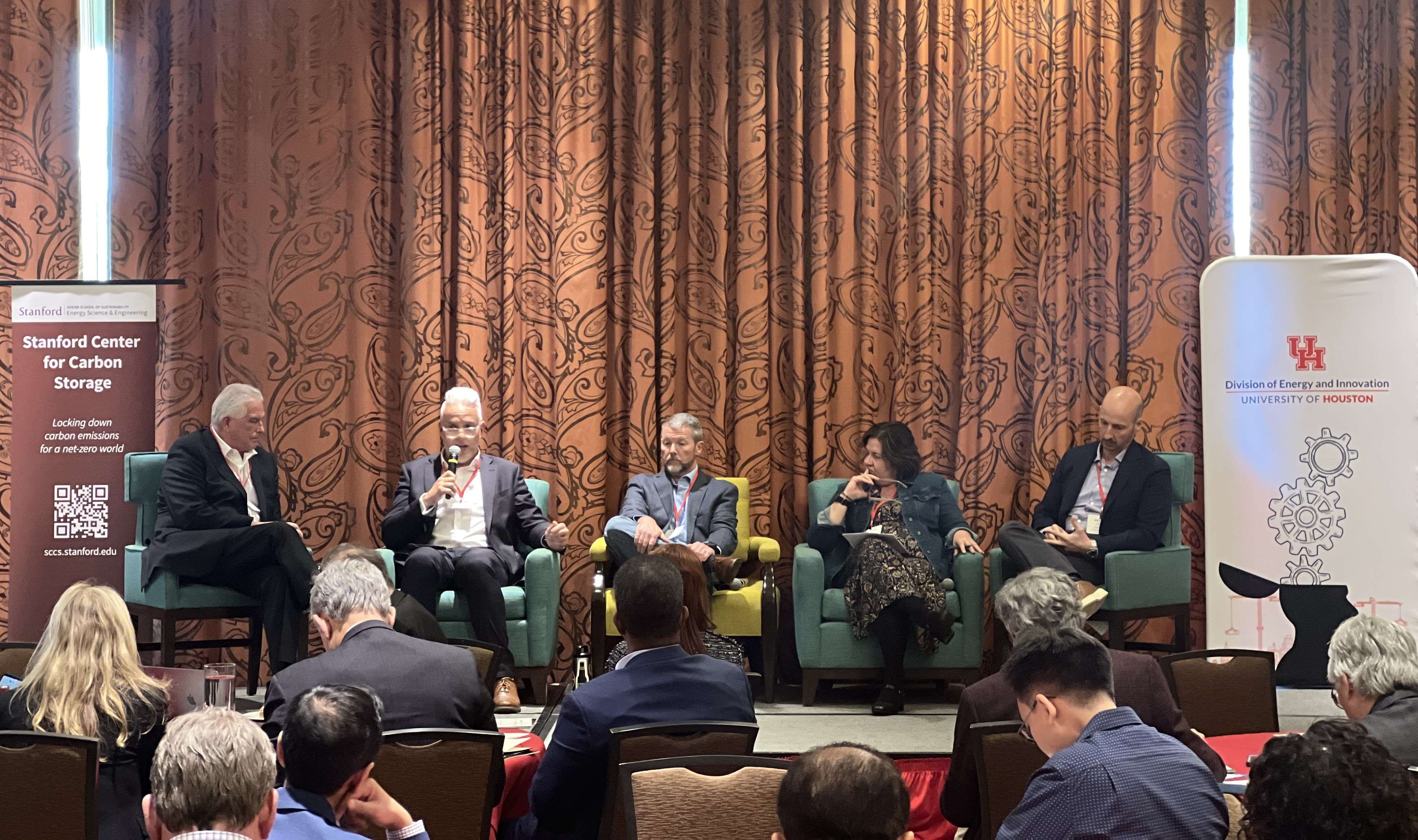
On April 7, The Stanford Center for Carbon Storage and the Center for Carbon Management (CCME) in Energy at UH Energy brought together industry leaders, policymakers, and researchers for a timely discussion on the role of CO2-enhanced oil recovery (EOR) in advancing energy security and lower-carbon fuel systems. The event featured technical sessions, panel discussions, and a collaborative workshop.
Charles McConnell, executive director of CCME, Sarah Saltzer, managing director of the Stanford Center for Carbon Storage (SCCS), and Sally Benson, co-director of SCCS kicked off the day’s events. They emphasized the importance of CO2-EOR as a bridge between conventional energy systems and emerging low-carbon strategies. Chuck highlighted the strategic opportunity for EOR to support both domestic energy security and emissions management, noting that the industry is at an advantage as it can leverage existing infrastructure and decades of operational experience.
Discussions throughout the day revolved around the evolving role of CO2-EOR within the energy transition. Speakers emphasized that EOR, which has traditionally been viewed as a production technology, is increasingly being treated as a tool for reducing the carbon intensity of fuels and supporting hard-to-abate sectors. In particular, participants from aviation reinforced the need for pragmatic, carbon-conscious solutions as they pointed to the sector’s continued reliance on liquid fuels as alternatives such as electrification or hydrogen remain limited.
The forum also addressed the economic and operational realities of EOR deployment. While not typically the first choice compared to primary production, participants noted that EOR becomes especially valuable in mature fields and technically challenging reservoirs, where it can extend asset life and unlock additional recovery.
A highlight of the event was an interactive breakout session, where participants worked in groups to identify priority themes for advancing CO2-EOR. Each group outlined key challenges, stakeholders, and near-term milestones, followed by a voting process to determine the most impactful themes. Top priorities included strengthening community engagement, improving public acceptance, and enhancing policy support for EOR development. Participants also emphasized the importance of building credible external advocacy to better communicate the role of EOR in a lower-carbon energy system. Reflecting on day's discussions, McConnell said: "This event attracted the leaders in the carbon capture, utilization and storage (CCUS) market to promote commercialization of the technology and the importance of EOR to create sustainable value for investment. CCUS EOR provides a proof point that environmental responsibility and energy security are not mutually exclusive."
The workshop concluded with a networking reception, providing attendees with an opportunity to continue discussions and explore collaboration opportunities. Overall, the event reinforced the importance of cross-sector dialogue in positioning CO2-EOR as a practical and scalable solution to realize energy security and emissions reduction strategies.