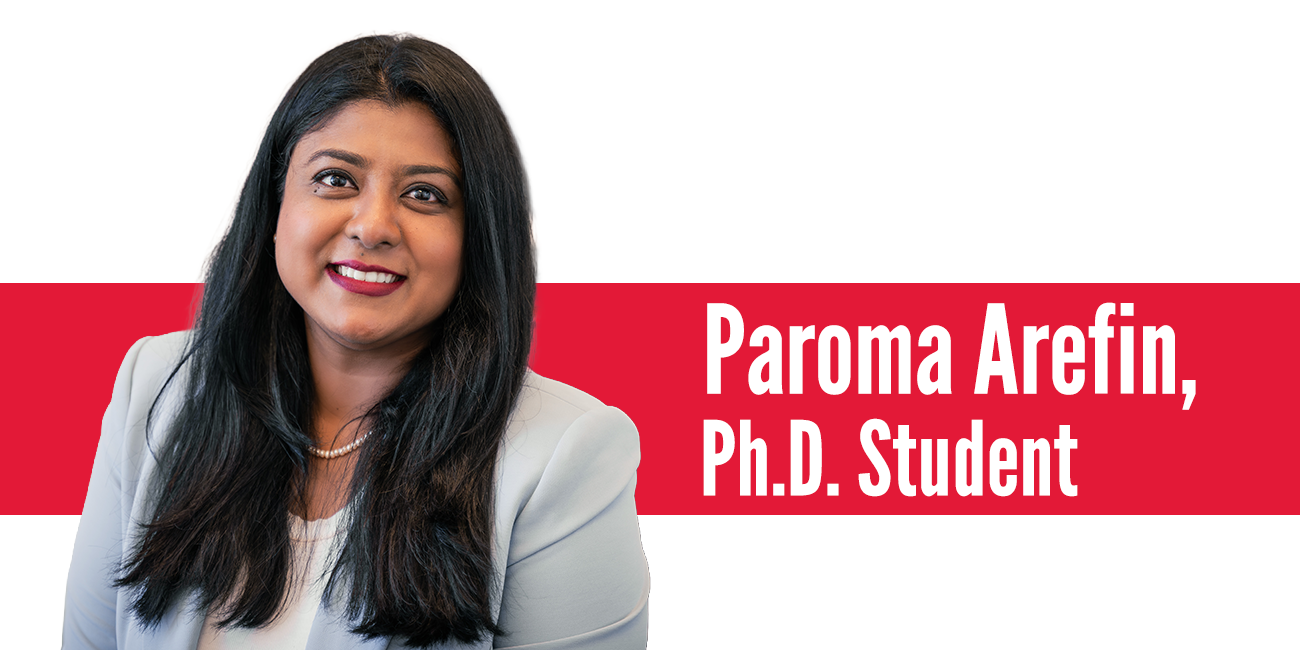
A native of Bangladesh, Ph.D. student Paroma Arefin has been surrounded by health science professionals her whole life. Her father, a physician and professor, and her mother, a professor, fostered early conversations about medicine, education and the value of lifelong learning. Along with her sister's background in health economics, these influences sparked a deeper curiosity about how health systems function beyond individual patients and prescriptions.
After completing her Master of Pharmacy in Dhaka, Bangladesh, Arefin served as a senior scientist at the Bangladesh Council of Scientific and Industrial Research.
“I wanted to move beyond product development and understand how therapies perform at a system level, how they’re used in real-world settings and how decisions are made around them,” Arefin said.
Arefin later moved to the U.S. to pursue a Ph.D. at the University of Houston College of Pharmacy (UHCOP) within the Department of Pharmaceutical Health Outcomes and Policy (PHOP), a program she said stood out for its strength in real-world evidence and policy research.
Reframing Healthcare Spending
Arefin’s interests lie in examining how healthcare systems, policy and access influence patient outcomes, especially in the areas of diabetes, arthritis and oncology. More recently, she has focused on how healthcare expenditures are interpreted in policy discussions, an approach she said is supported by her advisor, Sujit S. Sansgiry, Ph.D., who encourages independent thinking while providing guidance.
One of her recent projects examines patterns in diabetes management using real-world data, including the use of GLP‑1 receptor agonists. While these therapies are often discussed primarily in terms of high cost, Arefin said her findings highlight a different concern.
“Lower spending should not automatically be seen as a success,” Arefin said. “Instead, we need to ensure that patients are receiving appropriate and timely care.”
By examining policies such as insulin cost caps, her work reframes the conversation from “Why are these drugs expensive?” to “Why are some patients unable to access them at all?” Arefin said improving coverage for effective therapies may increase short-term spending but can prevent complications and reduce long-term costs.
Even within the patterns she studies, Arefin acknowledges that the data only captures patients who interact with the healthcare system.
“There are many individuals who are not even in the data because they could never seek care at all likely due to barriers to access,” Arefin said. “That’s what concerns me the most — the people we don’t see.”
At UHCOP, Arefin is deeply involved in student leadership and mentorship. She serves as president of the UH Graduate Students and Alumni in Pharmaceutical Health Outcomes and Policy Association (GPA), vice president of the UH International Society for Pharmacoeconomics and Outcomes Research (ISPOR) Student Chapter, and as a representative on the Dean’s Graduate Student Advisory Council. She said these roles have strengthened her ability to understand and advocate for diverse perspectives, an approach that also shapes her research.
A Career Focused on Better Outcomes
She said she hopes to pursue a career in the pharmaceutical industry, academia or policy research, where she can continue bridging the gap between data-driven evidence and real-world healthcare decisions.
Arefin said she believes success is not defined by titles or publications alone.
“My job is to generate evidence that informs policy and guides better healthcare decisions,” she said. “At the end of the day, the goal is simple: to leave people's lives a little better than we found them. If something I discover helps someone make a better decision tomorrow than they could make today, that's meaningful to me.”
That motivation continues to ground her work, serving as a reminder of the real people behind the data she analyzes.
“No one should feel alone or unsupported when they are already fighting for their life,” Arefin said. “If our work doesn’t make people’s lives better, then we probably need to ask ourselves why we’re doing it.”