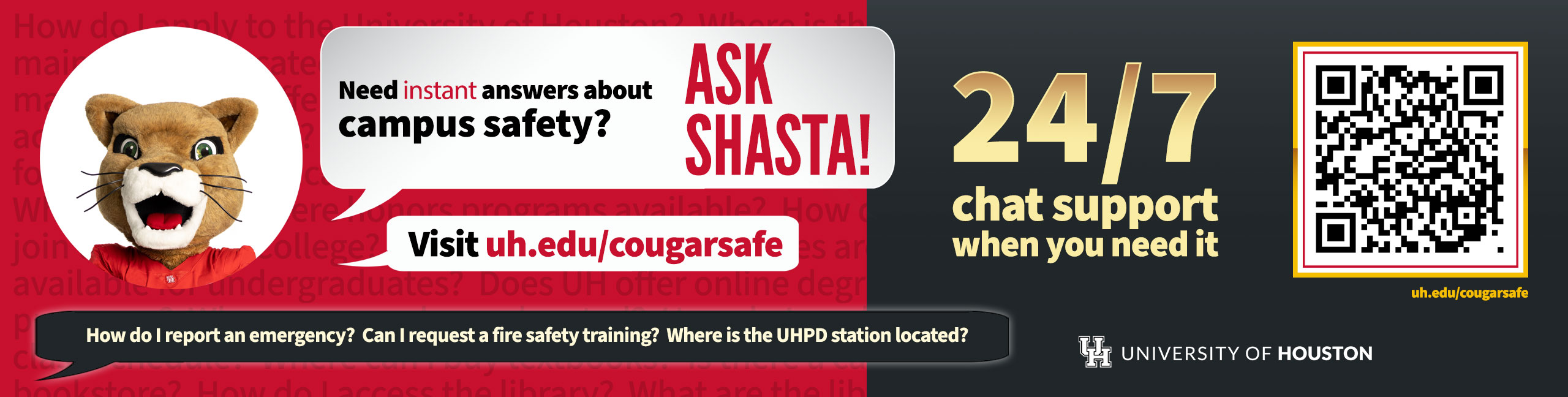
Whether it's a question about financial aid at 2 a.m. or help finding campus resources after business hours, more University of Houston students are turning to Shasta, the University's AI-powered chatbot, for answers.
Over the past year, the number of UH departments using the chatbot has more than doubled, growing from 11 departments to 23. The latest rollout added six departments, including Stay Cougar SAFE, CASA Testing Services and UH Libraries, expanding access to around-the-clock support across campus.
As more departments adopt the technology, University Information Technology continues refining the onboarding process to improve the chatbot's effectiveness.
"As we continue to launch more, as part of our onboarding process, we have a web content review that we do now for all our departments," said Mark Rosanes, UIT AI solutions manager. "That was added with phase three and allows us to review web content and make sure it's optimized for the chatbot to crawl properly."
The implementation has unfolded in four phases, with each phase providing new insights into how departments can better prepare their websites for AI-powered assistance. Following the latest expansion, Rosanes and his team have already identified enhancements they plan to make before phase five.
Meeting Students When They Need Help Most
One of the most significant findings since the chatbot's launch is when students are using it.
Nearly 40% of all Shasta chatbot conversations occur outside normal office hours, highlighting a growing demand for support beyond the traditional workday. According to Rosanes, students have sought assistance as late as 2 a.m.
"It's important that they're able to get the answers they need whenever they need them and not have to wait until daytime to talk to somebody or wait for an email response," said Rosanes.
Since its launch, the chatbot has handled 72,433 conversations, generating 112,104 responses and achieving an 83% resolution rate.
Reducing Wait Times, Increasing Access
Several campus departments have already experienced measurable benefits.
Student Business Services was among the first departments to deploy the chatbot. Since then, the department has seen a noticeable reduction in customer service calls during one of its busiest periods of the year. Calls dropped from 3,417 in August 2024 to 2,807 in August 2025.
"At the end of the day, we're trying to serve students the best way we can," said Kevin Burns, Bursar for Student Business Services. "We will always need people to do things, but if a chatbot can assist in that work, that's the beauty of artificial intelligence. It helps us become more efficient and responsive."
Cougar Card Services added the chatbot during phase two and has experienced similar results.
"The Shasta chatbot has had a huge impact on the number of calls and emails we receive for general questions," said Daisy Del Fierro, assistant director of Cougar Card Services. "It makes it easier for students to get answers without having to navigate our entire website, and the more people use it, the more we learn about what information we should clarify or add."
Auxiliary Services, which oversees programs such as the UH Campus Store, CTAP, Dining Services and Vending Services, has also benefited from the additional support channel.
"The chatbot has helped us tremendously by guiding students to assistance resources after hours, reducing email and call volume, and creating another touchpoint to inform students about Campus Store, CTAP, Dining and Vending programs," said Dakota Rogers, Auxiliary Services program manager.
Supporting Service Through Technology
University leaders emphasize that the chatbot is not intended to replace employees but to complement existing customer service efforts by answering routine questions and directing users to the resources they need.
As Shasta expands across more departments, its growing usage demonstrates how artificial intelligence can enhance access to information, provide support beyond office hours and help university staff focus on more complex student needs.
With 23 departments now participating and additional improvements planned, Shasta is becoming an increasingly important part of how UH connects students, faculty and staff with campus services.