By Agnes DeFranco, Minwoo Lee, Hospitality Analytics and Innovation Lab, Conrad N. Hilton College of Global Hospitality Leadership, University of Houston; Hawon Shim, Korean Broadcasting System (KBS)
Restaurant Branding
The restaurant business is a dynamic blend of hospitality, food, experience, and excitement. Working in the restaurant business is a joyful journey of discovery as one learns new culinary terminology, exploring flavors, and deepening one’s appreciation for any cuisine.
In Andy St. John’s case, as a trained chef from Culinary Institute of America and with a master’s degree in hospitality, tourism, and management at Purdue University, he always has the restaurant business in his heart, started his career in Philadelphia and quickly went to Las Vegas, focusing in luxury, higher-end restaurants at Aria, Virgin, and Bellagio. Now, the Director of Operations of Wakuda, a specialty high-end Japanese restaurant within The Venetian family, St. John is the one responsible for upholding the high standard of hospitality where the food quality is always exceptional.
It's All About the Brand
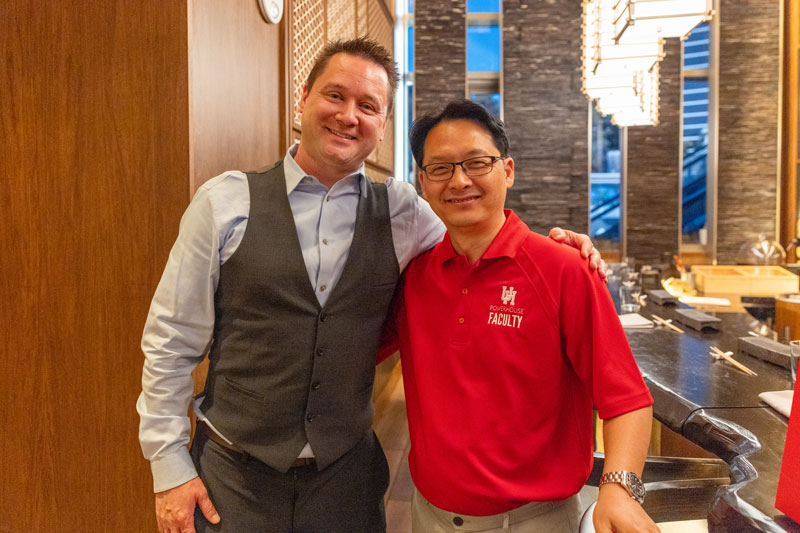
So, how does branding set Wakuda apart from its competitors in The Venetian and the Las Vegas restaurant scene? Cultural branding plays a critical role. The name on the door, Wakuda, represents Chef Tetsuya Wakuda’s vision of modern Japanese dining. Every detail reflects his brand’s identity of refined, approachable, and engaging.
From the food and drinks to the service, everything is thoughtfully curated. Understanding how sake pairs with food is enlightening as each pairing sparks new insights and sensory experiences.
Besides food and beverages, ambiance is equally crucial. The music, the visual elements, the aroma of the food, all contribute to a vibrant, immersive atmosphere.
The staff is the hospitality element as they are not merely servers but professionals who genuinely care about guiding guests through their dining experience. Their authenticity and commitment to excellence are rare and deeply appreciated.
Ultimately, hospitality means welcoming guests, educating them without judgment, and accommodating their needs, whether dietary restrictions or personal preferences. Chef Wakuda’s brand succeeds in making Japanese cuisine accessible and enjoyable for all, while maintaining a high standard of execution and cultural integrity.
Branding is Technology
In today’s business world, technology is a must. From computers generated daily operations reports to online customer reviews, to guests making reservations and permission-based marketing, technology is everywhere. And after the meal, Wakuda also sends all guests a text message with a link to evaluate them to gain that feedback.
However, it is not about reports or reviews. It is about what the team will do with the reports and reviews. For example, if there is a guest comment that Wakuda can improve on, that will be discussed in their weekly manager meeting on Saturdays where all the chefs and managers get together and share collectively that information. That is making adjustments for progress. Without the new technology for customer feedback, and if something went wrong with a guest, he or she would complain, and the restaurant would never know nor or have the opportunity to improve. Thus, technology makes better operators pay attention to feedback.
Technology also enhances cooking techniques. Wakuda has a freezer that goes to negative 100F. So, if they need to freeze fish for the parasitic controls, that can be achieved. Las Vegas is in a desert; thus, technology has to be on their side, in order for Wakuda to fly in fresh fish and seafood, not frozen.
Branding is Balancing Culture and Authenticity
Dining is an experience, regardless of whether the food is Japanese, Korean, Italian or any other culture. The staff has been very polite, executing genuine and authentic kindness. Then comes the quality. For Wakuda, everything, from sake to fish, meats, vegetables, soups, are all of high quality. The quality and integrity of execution should all be considered. If a server sees a guest struggling with something, simply go up to the table and assist, in a very kind way, not in a way that demeans the guest or makes the guest feel uncomfortable.
Branding is Customer Experience
However, branding is more than computers. It is really the experience at Wakuda begins with the entire guest journey, how their reservations are taken, whether on the phone or online. Of course, Wakuda cannot control if their Uber driver is lost on the way, or that their plane is delayed due to bad weather, or if the guests won big or lost a little in the casino. However, once they are at the restaurant, the experience continues. The maitre d' and the host team will always cordially welcome the guests with a smile to brush all the negative things away.
The welcome needs to be genuine. The team will then guide the guests through the restaurant, tour them around the dining room, point out the art, point out the amenities, point out the highlights, the open kitchen, and the sushi counter. If there's a chef making sushi, the staff will always introduce guests to the sushi chef because the chefs are very interactive, charming, and outgoing.
So, all of those things only cost a couple of minutes of the staffs’ and the guests’ time. And immediately, that sets the stage to the guests they are welcomed, much like welcoming a dear friend into your home. Thus, the staff is also the guides for Wakuda, that they are the only ones that matter to the staff. St. John wants to make sure that the guests feel like they are the only ones in the room, the only ones who matter!
Hospitality Education and Leadership
When asked about return on investment of his education in culinary and hospitality, St. John did not hesitate the positives. It is not only about degrees and knowledge. It is also six years for him to understand life. He shares that the classes he took and the people he interacted with developed him to set him up for success in life. For him, going off to college, living away from home, paying his own bills, figuring out how to put gas in his car, all the life skills that one has to be responsible to oneself. There is going to be a motivation there to work hard, get as high an income as possible, as fast as possible, so then you can get on with your life and do those things. Although admitting that education is not inexpensive, but it “paid off” for St. John as he learned about life that otherwise he would not.
Group dynamics is another life lesson. All those challenging group projects also taught him how to work with the different personality traits, that while teamwork is necessary, sometimes one must put more into a team just to ensure a good grade since others do not carry their own weight. That is life. Thus, all these life situations in school prepare him well, that he realizes the value of work and the integrity one needs to uphold. Then, be humble, keep one’s head down, and no matter what is going on, hold your goals right in front of you, and do the very best to can. To St. John, that’s the value of education.
Finally, it is the sense of belonging, to be part of a prestigious organization that awards you the degree at the end. At graduation, when you walk across the stage, you will appreciate that sense of accomplishment. Education is highly individual, yet it also offers many things that will add to the benefit of you growing up in life and maturing and becoming more savvy or more intelligent, and also a better view of business acumen. Be positive and make an impact on others with the gifts who have or will receive. That is the ultimate hospitality!