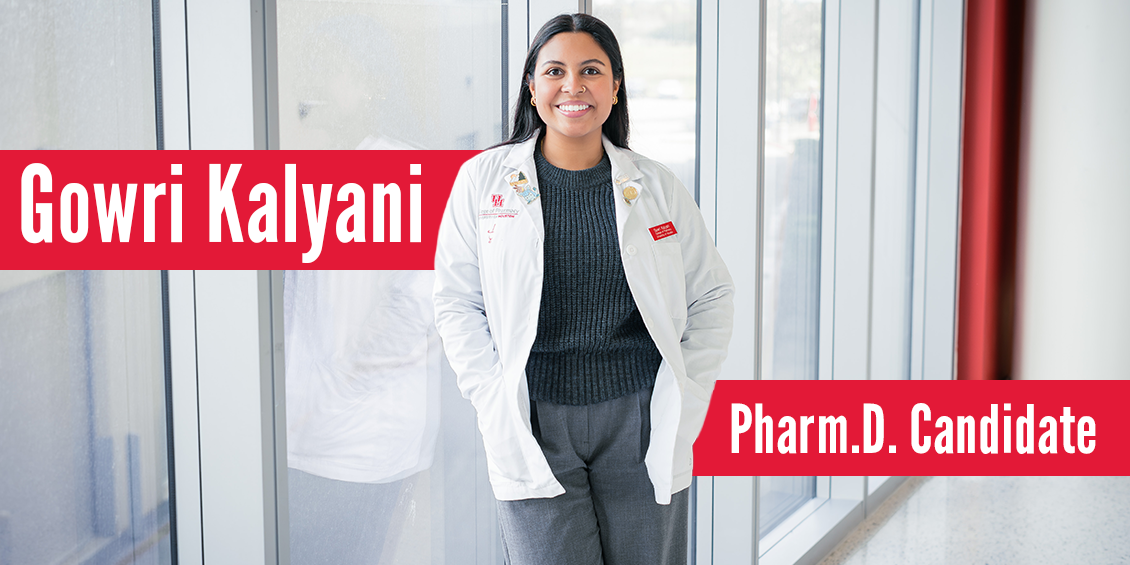
Gowri Kalyani’s path to pharmacy began in high school when a family member was diagnosed with cancer. She saw firsthand how pharmacists guided her loved one’s transitions of care.
“They were incredibly helpful in explaining discharge medications and what to expect with chemotherapy, especially when those details weren’t fully addressed during the discharge process,” she said.
Once in college, she became a pharmacy technician, further igniting her career calling and leading her to apply to the University of Houston College of Pharmacy (UHCOP) Pharm.D. program.
Pharmacy Mindset
As an undergraduate, Kalyani often held herself back from opportunities because she was too nervous to apply. Understanding that pharmacy is a small world, she vowed to change that once she entered UHCOP.
Guided by her newly adopted mindset that “it never hurts to apply,” Kaylani gained hands-on research experience early in her pharmacy school journey as a P2 through Helping Everyone Achieve a LifeTime of Health - Future Addictions Scientist Training (HEALTH-FAST), a collaboration between UH and The University of Texas MD Anderson Cancer Center that pairs doctoral students with faculty mentors. Through the HEALTH-FAST program, Kalyani studied under UHCOP Professor Meghana Trivedi, Pharm.D. (’03), Ph.D. (’04), BCOP.
Working with Trivedi, Kalyani studied adherence to oral endocrine therapy in patients with breast cancer and analyzed refill data and longitudinal trends, uncovering significant gaps.
“Something I didn’t realize is how much adherence can drop off for these patients,” she said. “Sometimes we think, ‘They were diagnosed with cancer — they're going to want to stay really adherent to their medications.’ And that’s just not the case, especially for underserved communities.”
Their research found that adherence is often a reflection of the socioeconomic and structural barriers patients face.
Kalyani’s and Trivedi’s research was accepted at UHCOP’s inaugural Clinical and Translational Research Symposium in 2024 and the Hematology/Oncology Pharmacy Association Annual Conference in 2025, with publication forthcoming.
Educating the Community
The significant gap in health care access has been a strong motivator for Kalyani to advocate for all patients. As an AmeriCorps pharmacy intern and advocate at Legacy Community Health, a federally qualified health center serving uninsured and underserved patients and individuals with HIV, she provides vaccines, medication counseling and community outreach.
“I’ve always believed that pharmacists are the most accessible health care providers,” she said. “Getting the opportunity to educate has taught me so much on how to interact with the community, how to show compassion and be patient.”
Leading by Example
Beyond research and rotations, Kalyani also holds a strong commitment to peer education. She helped lead literature evaluation workshops with Never Generic, a student-run pharmacy podcast, and she has also held leadership positions such as fundraising chair for the Hispanic Pharmacists Student Association, and vice president of membership for the American Pharmacists Association - Academy of Student Pharmacists. She is also a member of the UT Health HIV Community Advisory Board.
“I wanted to grow and learn how to communicate and work with others,” she said. “I challenged myself to take on leadership roles to build skills and learn how to manage high- level responsibilities. It grew from there, and it’s been incredibly helpful overall.”
Currently a Longitudinal Advanced Pharmacy Practice Experience student at the University of Texas Medical Branch, Kalyani has found transplant ambulatory care rewarding but discovered a particular passion for primary care ambulatory medicine.
“I really enjoyed managing chronic conditions such as diabetes, hypertension, heart failure and hyperlipidemia,” she said. “It was the perfect balance between day-to-day patient interaction and the opportunity to adjust treatment regimens, and it felt like the best use of what we learn as pharmacists.”
Looking back, many of the experiences that shaped her from — research and leadership to patient advocacy — began with a willingness to put herself out there. As she embarks on the road to residency, Kalyani plans to carry that same mindset forward and encourages other students to apply for opportunities even if they seem out of reach.