Most students will tell you that organic chemistry can be challenging. For Salena Kabani, a health major at the University of Houston College of Education, that challenge sparked an interest that led her to work with UH Physics Professor Seamus Curran.
Countless hours in the lab and several scientific studies later, Kabani earned Researcher of the Year honors based on her contributions to work published in the Philosophy & Reason undergraduate research journal. This fall, she’s being featured on UH’s Scholars Walk, a digital display near the Student Center honoring outstanding Coogs.
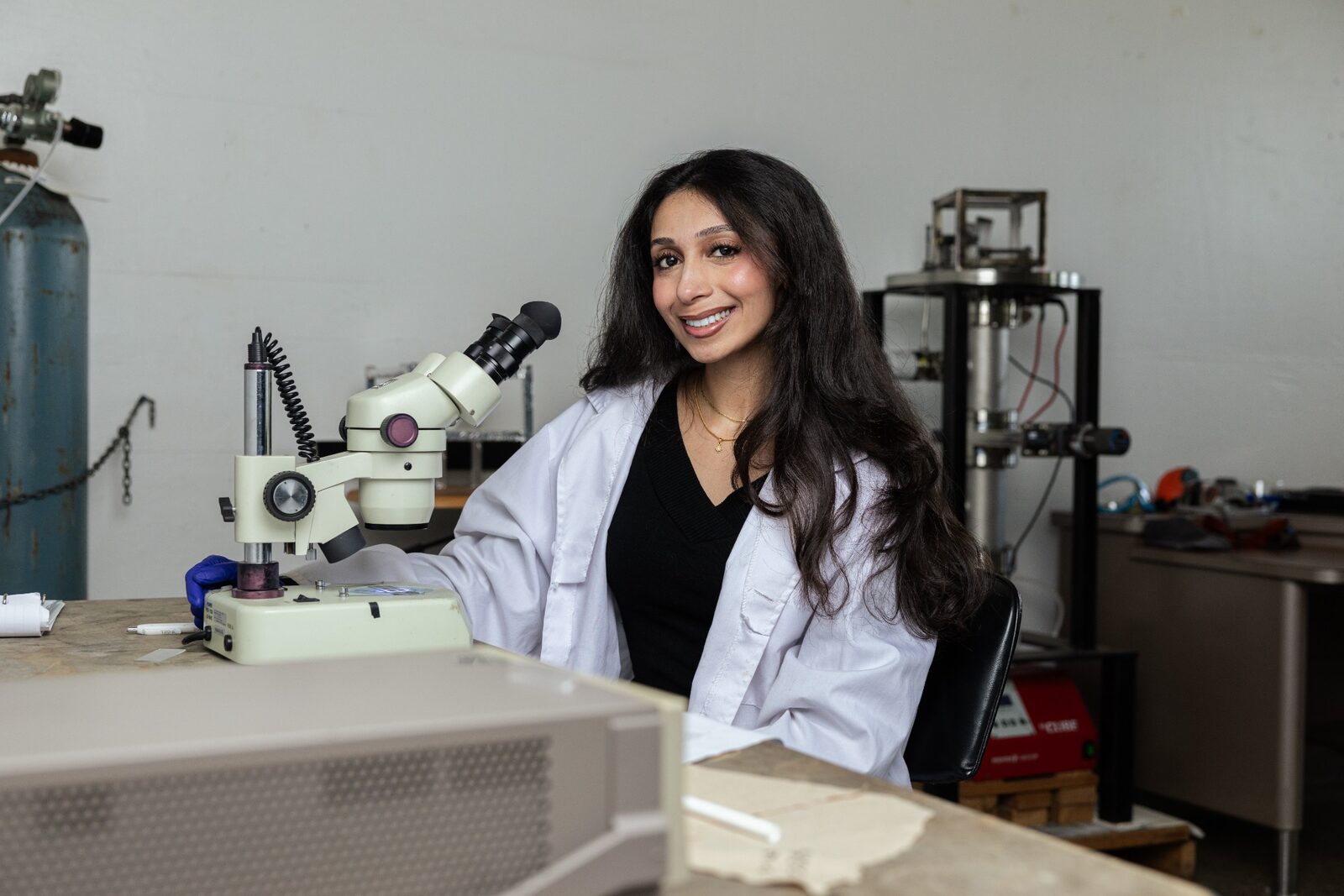
“As a health promotion major, I’ve learned about prevention at the population level, and research allowed me to consider issues at a deeper level,” she said. “It taught me to ask better questions and understand the ‘why’ behind complex issues.”
Research wasn’t part of Kabani’s original plan. The aspiring dentist was already navigating college as a first-generation student. “I was trying to figure everything out myself while also making sure my siblings would have an easier path,” she said.
But when she saw an opportunity to follow her curiosity, Kabani didn’t hesitate. She wanted to dig deeper into chemistry’s connection to real-world problems, and an instructor suggested she reach out to Curran, who heads the Nanophysics Research Group and serves as associate director of the Advanced Manufacturing Institute at UH.
Although she lacked research experience, Curran gave her a chance. Gradually, she progressed from helping with smaller laboratory and administrative tasks to working on research related to pharmaceutical chemistry, environmental health and materials science. She contributed to four published papers, serving as first author on several.
Noting that Kabani is still an undergraduate, Curran said her success in his lab speaks for itself. “She has delivered what most graduate students would love, recognized publications. She is a credit to her own drive and the college that enabled her to fit into my research program.”
Her first-author publications include “The Role of Chiral Synthesis and Carbon-Carbon Bond Formation in Modern Pharmaceuticals” and “Sol-Gel Coatings Masonry Sealer for PFAS-Replacement Coatings that Reduces Sorptivity, Acid-Induced Degradation, and Internal Steel Corrosion in Masonry Materials,” both published in the journal Philosophy & Reason.
Her co-authored papers include “Toward Suppression of Polycyclic Aromatic Hydrocarbons Leaching from Creosote-Treated Wood” in ACS Omega and “The Wonders of Raman Spectroscopy” in Philosophy & Reason.
Curran and collaborator Ken Russell, a dean at Barton College in North Carolina, created Philosophy & Reason to provide undergraduate students with an opportunity to publish their research; Researcher of the Year is awarded based on research contributions within the group of students selected for the journal.
The work has been a balancing act for Kabani. While serving as first author on one of the papers, she was also preparing for the Dental Admission Test, or DAT, requiring her to juggle high-level research expectations with intensive academic preparation.
“As lead author, I handled the writing, research and visual components of the paper while studying for my DAT,” she said. “It was a lot to manage, but I truly enjoyed the process and found myself wanting to learn even more beyond what was required. As a first-generation college student, I never imagined I would publish research and receive recognition for my work.”
Her research explores how scientific innovation can directly improve lives, from lowering environmental health risks to advancing pharmaceutical development. The experience has also shaped her long-term goals in healthcare.
“The most rewarding part has been seeing how chemistry explains problems that initially seem unrelated,” Kabani said. “It helped me understand how science connects to real-world consequences.”
Now preparing for a career in dentistry, Kabani believes the same skills will help her become a more thoughtful and analytical healthcare provider.
Looking ahead, she hopes her story motivates other students to take a risk.
“You shouldn’t limit yourself because you feel underqualified,” she said. “One conversation can open a door you didn’t even know existed.”